question 9 of 11 > let a(x)=∫_a^x f(t)dt, where f is continuous and differentiable. find f(c), if c is an…
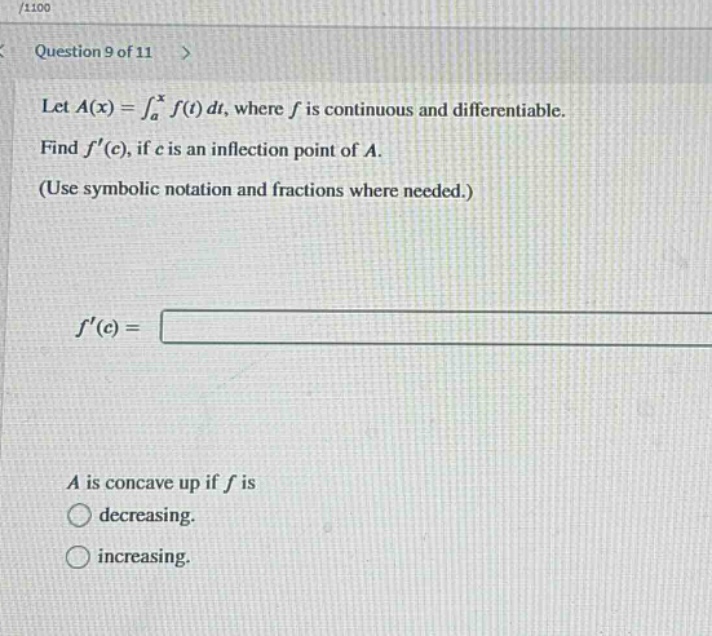
question 9 of 11 > let a(x)=∫_a^x f(t)dt, where f is continuous and differentiable. find f(c), if c is an inflection point of a. (use symbolic notation and fractions where needed.) f(c)= a is concave up if f is decreasing. increasing.
Answer
Explanation:
Step1: Apply the Fundamental Theorem of Calculus
By the Fundamental Theorem of Calculus, $A'(x)=f(x)$.
Step2: Differentiate again to get the second - derivative of $A$
Differentiating $A'(x)$ with respect to $x$, we have $A''(x)=f'(x)$.
Step3: Use the property of inflection points
Since $c$ is an inflection point of $A$, then $A''(c) = 0$. Because $A''(x)=f'(x)$, when $x = c$, $f'(c)=0$.
For the multiple - choice part: We know that the concavity of $A$ is related to the sign of $A''(x)$. Since $A'(x)=f(x)$ and $A''(x)=f'(x)$, $A$ is concave up when $A''(x)>0$, that is when $f'(x)>0$. When $f'(x)>0$, the function $f$ is increasing.
Answer:
$f'(c)=0$ $A$ is concave up if $f$ is increasing.