question 11 (1 point)\nthe number of wild flowers growing each year in a meadow is modeled by the function…
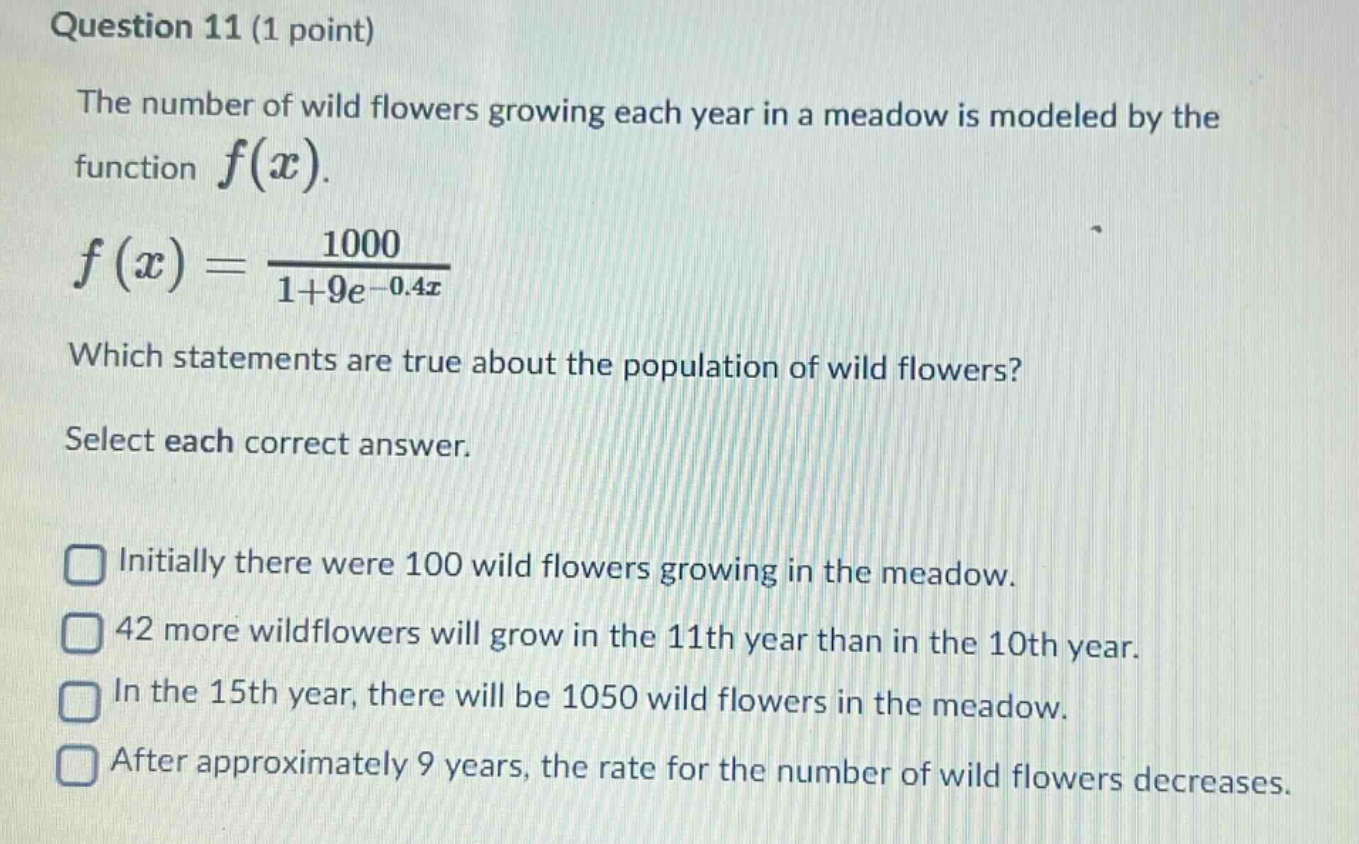
question 11 (1 point)\nthe number of wild flowers growing each year in a meadow is modeled by the function $f(x)$.\n$f(x)=\frac{1000}{1 + 9e^{-0.4x}}$\nwhich statements are true about the population of wild flowers?\nselect each correct answer.\ninitially there were 100 wild flowers growing in the meadow.\n42 more wildflowers will grow in the 11th year than in the 10th year.\nin the 15th year, there will be 1050 wild flowers in the meadow.\nafter approximately 9 years, the rate for the number of wild flowers decreases.
Answer
Explanation:
Step1: Find the initial number of flowers
Set (x = 0) in (f(x)=\frac{1000}{1 + 9e^{-0.4x}}). Then (f(0)=\frac{1000}{1+9e^{0}}=\frac{1000}{1 + 9\times1}=\frac{1000}{10}=100). So the statement "Initially there were 100 wild - flowers growing in the meadow" is true.
Step2: Calculate the number of flowers in 10th and 11th year
For (x = 10), (f(10)=\frac{1000}{1+9e^{-0.4\times10}}=\frac{1000}{1 + 9e^{-4}}\approx\frac{1000}{1+9\times0.0183}=\frac{1000}{1 + 0.1647}\approx859). For (x = 11), (f(11)=\frac{1000}{1+9e^{-0.4\times11}}=\frac{1000}{1+9e^{-4.4}}\approx\frac{1000}{1+9\times0.0123}=\frac{1000}{1+0.1107}\approx900). The difference (f(11)-f(10)\approx900 - 859 = 41\approx42). So the statement "42 more wildflowers will grow in the 11th year than in the 10th year" is true.
Step3: Calculate the number of flowers in 15th year
For (x = 15), (f(15)=\frac{1000}{1+9e^{-0.4\times15}}=\frac{1000}{1+9e^{-6}}\approx\frac{1000}{1+9\times0.0025}=\frac{1000}{1+0.0225}\approx978\neq1050). So the statement "In the 15th year, there will be 1050 wild flowers in the meadow" is false.
Step4: Analyze the rate of change
The function (y = f(x)=\frac{1000}{1+9e^{-0.4x}}) is a logistic - growth function of the form (y=\frac{L}{1 + ae^{-bx}}) where (L = 1000), (a = 9), (b=0.4). The rate of change of a logistic - growth function (y=\frac{L}{1+ae^{-bx}}) first increases and then decreases. The inflection point of the logistic - growth function (y=\frac{L}{1+ae^{-bx}}) occurs at (x=\frac{\ln a}{b}). Substituting (a = 9) and (b = 0.4), we get (x=\frac{\ln9}{0.4}=\frac{2.1972}{0.4}\approx5.5). After the inflection point, the rate of growth decreases. So the statement "After approximately 9 years, the rate for the number of wild flowers decreases" is true.
Answer:
Initially there were 100 wild flowers growing in the meadow. 42 more wildflowers will grow in the 11th year than in the 10th year. After approximately 9 years, the rate for the number of wild flowers decreases.