question: 12\nis it possible to construct an inverse to the sine function if the domain of the sine function…
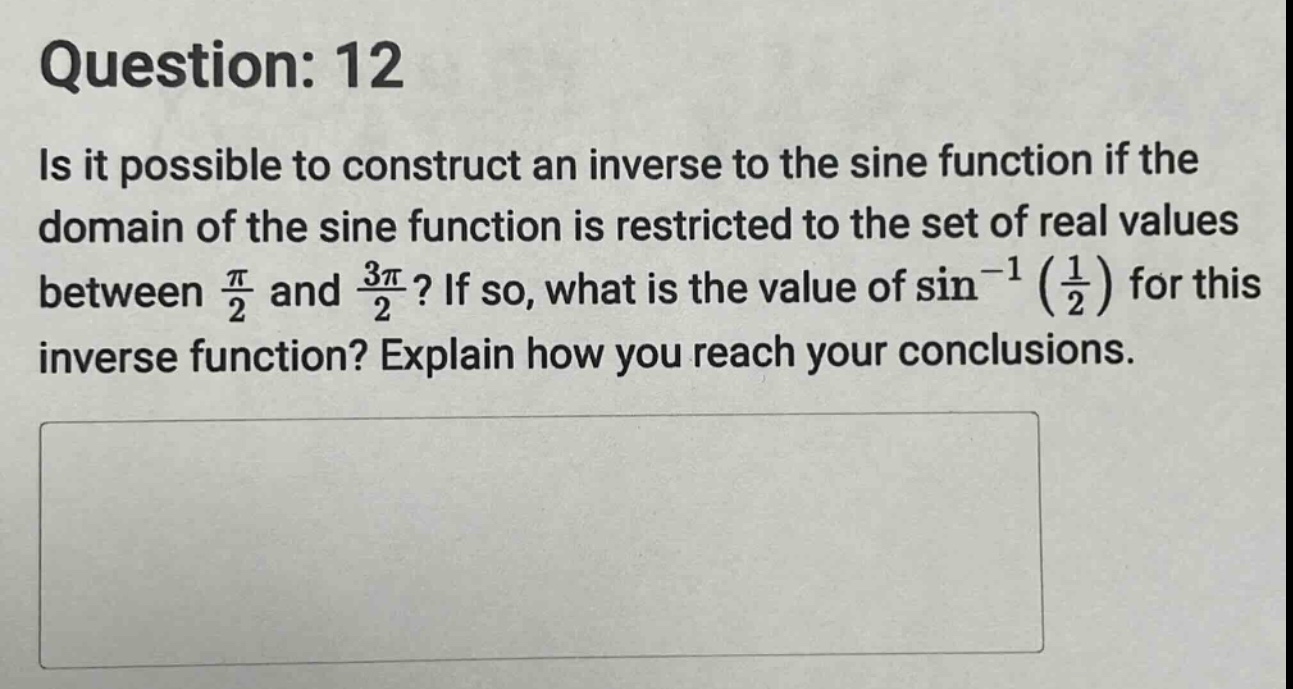
question: 12\nis it possible to construct an inverse to the sine function if the domain of the sine function is restricted to the set of real values between $\frac{pi}{2}$ and $\frac{3pi}{2}$? if so, what is the value of $sin^{-1}(\frac{1}{2})$ for this inverse function? explain how you reach your conclusions.
Answer
Explanation:
Step1: Recall the property of one - to - one function
A function has an inverse if and only if it is one - to - one. The sine function (y = \sin(x)) is not one - to - one on the entire real line. But when the domain of (y=\sin(x)) is restricted to (\left[\frac{\pi}{2},\frac{3\pi}{2}\right]), it is one - to - one. The sine function (y = \sin(x)) is decreasing on the interval (\left[\frac{\pi}{2},\frac{3\pi}{2}\right]), so an inverse can be constructed.
Step2: Find the value of (\sin^{-1}\left(\frac{1}{2}\right)) in the restricted domain
We know that (\sin(x)=\frac{1}{2}). The general solutions of the equation (\sin(x)=\frac{1}{2}) are (x = 2k\pi+\frac{\pi}{6}) or (x=(2k + 1)\pi-\frac{\pi}{6},k\in\mathbb{Z}). In the domain (\left[\frac{\pi}{2},\frac{3\pi}{2}\right]), we set (\sin(x)=\frac{1}{2}). Let (x) be in the given domain. We know that (\sin\left(\frac{5\pi}{6}\right)=\frac{1}{2}) and (\frac{5\pi}{6}\in\left[\frac{\pi}{2},\frac{3\pi}{2}\right]). So for the inverse of (y = \sin(x)) with domain (\left[\frac{\pi}{2},\frac{3\pi}{2}\right]), (\sin^{-1}\left(\frac{1}{2}\right)=\frac{5\pi}{6}).
Answer:
Yes, it is possible. The value of (\sin^{-1}\left(\frac{1}{2}\right)) for this inverse function is (\frac{5\pi}{6})