question 13, 3.3.63 - gc\npart 3 of 5\nuse a graphing utility to graph f(x)=0.35x^4 + 0.3x^3 - 0.8x^2 + 5 on…
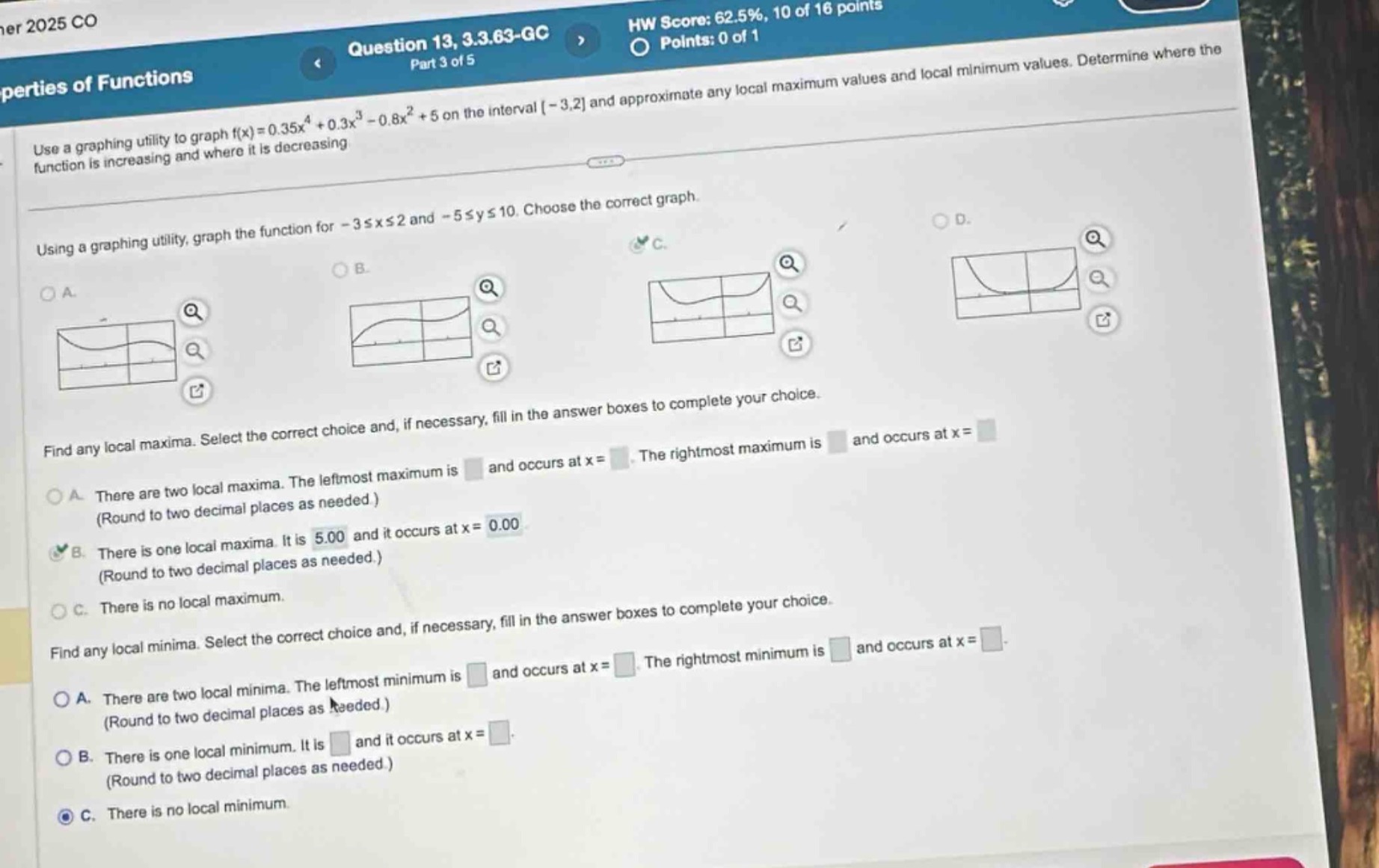
question 13, 3.3.63 - gc\npart 3 of 5\nuse a graphing utility to graph f(x)=0.35x^4 + 0.3x^3 - 0.8x^2 + 5 on the interval -3,2 and approximate any local maximum values and local minimum values. determine where the function is increasing and where it is decreasing\nusing a graphing utility, graph the function for -3≤x≤2 and -5≤y≤10. choose the correct graph.\nfind any local maxima. select the correct choice and, if necessary, fill in the answer boxes to complete your choice.\na. there are two local maxima. the left - most maximum is and occurs at x =. the right - most maximum is and occurs at x =\n(round to two decimal places as needed.)\nb. there is one local maxima. it is 5.00 and it occurs at x = 0.00\n(round to two decimal places as needed.)\nc. there is no local maximum.\nfind any local minima. select the correct choice and, if necessary, fill in the answer boxes to complete your choice.\na. there are two local minima. the left - most minimum is and occurs at x =. the right - most minimum is and occurs at x =\n(round to two decimal places as needed.)\nb. there is one local minimum. it is and it occurs at x =\n(round to two decimal places as needed.)\nc. there is no local minimum.
Answer
Explanation:
Step1: Recall derivative - based extrema rules
To find local maxima and minima of a function (y = f(x)=0.35x^{4}+0.3x^{3}-0.8x^{2}+5), we first find its derivative (f'(x)) using the power - rule ((x^{n})'=nx^{n - 1}). [ \begin{align*} f'(x)&=0.35\times4x^{3}+0.3\times3x^{2}-0.8\times2x\ &=1.4x^{3}+0.9x^{2}-1.6x\ &=x(1.4x^{2}+0.9x - 1.6) \end{align*} ]
Step2: Find critical points
Set (f'(x) = 0). We have (x = 0) or (1.4x^{2}+0.9x - 1.6=0). Using the quadratic formula (x=\frac{-b\pm\sqrt{b^{2}-4ac}}{2a}) for (ax^{2}+bx + c = 0), where (a = 1.4), (b = 0.9), and (c=-1.6). [ \begin{align*} x&=\frac{-0.9\pm\sqrt{0.9^{2}-4\times1.4\times(-1.6)}}{2\times1.4}\ &=\frac{-0.9\pm\sqrt{0.81 + 8.96}}{2.8}\ &=\frac{-0.9\pm\sqrt{9.77}}{2.8}\ &=\frac{-0.9\pm3.1257}{2.8} \end{align*} ] The solutions of (1.4x^{2}+0.9x - 1.6 = 0) are (x_1=\frac{-0.9 + 3.1257}{2.8}\approx0.80) and (x_2=\frac{-0.9 - 3.1257}{2.8}\approx - 1.44). All critical points (x=-1.44,0,0.80) are in the interval ([-3,2]).
Step3: Use the second - derivative test
Find the second - derivative (f''(x)=4.2x^{2}+1.8x - 1.6).
- For (x = 0): (f''(0)=-1.6<0), so (f(x)) has a local maximum at (x = 0). And (f(0)=5.00).
- For (x=-1.44): (f''(-1.44)=4.2\times(-1.44)^{2}+1.8\times(-1.44)-1.6=4.2\times2.0736-2.592 - 1.6=8.70912-2.592 - 1.6 = 4.51712>0), so (f(x)) has a local minimum at (x=-1.44).
- For (x = 0.80): (f''(0.80)=4.2\times(0.80)^{2}+1.8\times0.80-1.6=4.2\times0.64 + 1.44-1.6=2.688+1.44 - 1.6=2.528>0), so (f(x)) has a local minimum at (x = 0.80).
Answer:
For local maxima: B. There is one local maxima. It is (5.00) and it occurs at (x = 0.00) For local minima: A. There are two local minima. The left - most minimum is (f(-1.44)\approx3.47) and occurs at (x=-1.44). The right - most minimum is (f(0.80)\approx4.67) and occurs at (x = 0.80)