question 4 of 13 (a) estimate (by counting the squares) the total shaded area in the figure above. total…
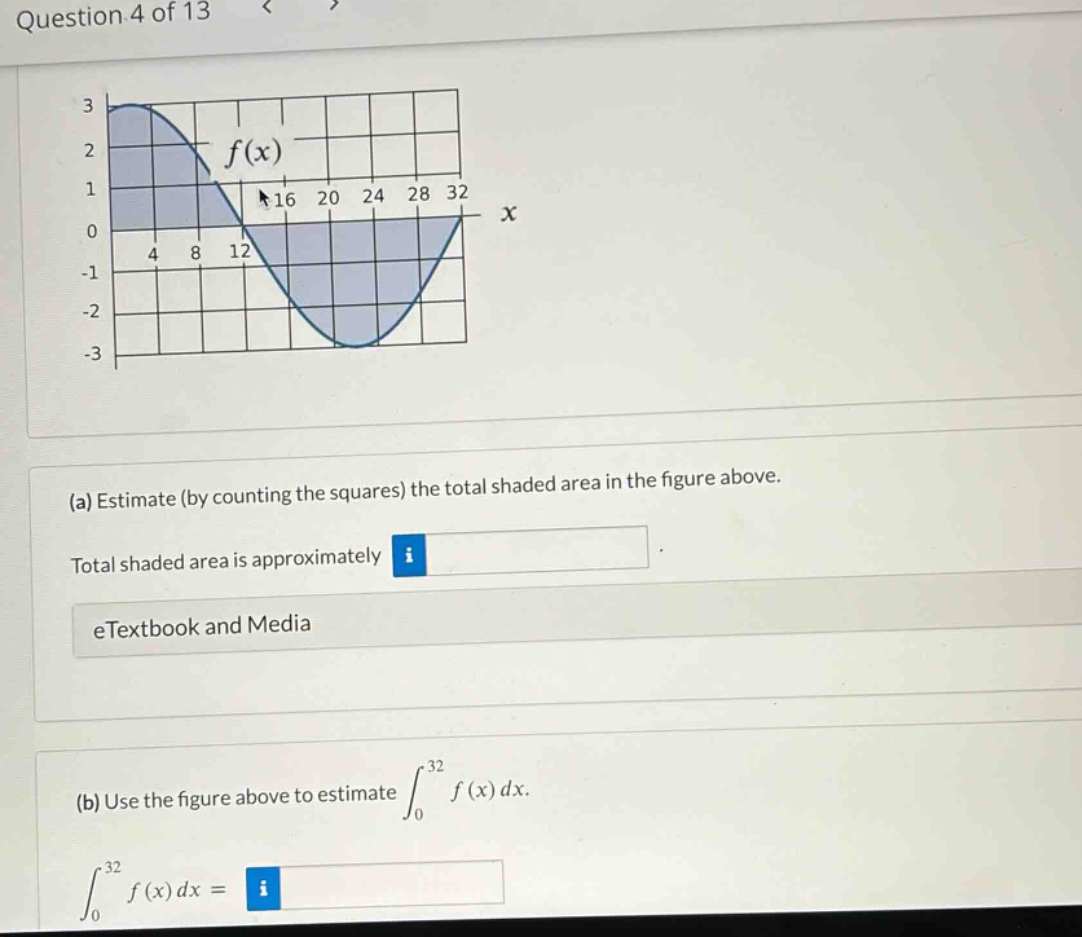
question 4 of 13 (a) estimate (by counting the squares) the total shaded area in the figure above. total shaded area is approximately i etextbook and media (b) use the figure above to estimate ∫₀³² f(x) dx. ∫₀³² f(x) dx = i
Answer
Explanation:
Step1: Count squares above x - axis
Count full and partial squares above x - axis. There are about 12 full - sized squares and some partial squares that combine to approximately 4 more full - sized squares. So, the area above x - axis is about 16 square units.
Step2: Count squares below x - axis
Count full and partial squares below x - axis. There are about 10 full - sized squares and some partial squares that combine to approximately 2 more full - sized squares. So, the area below x - axis is about 12 square units.
Step3: Calculate total shaded area
The total shaded area is the sum of the areas above and below the x - axis. Total shaded area = 16+12 = 28 square units.
Step4: Calculate the definite integral
The definite integral $\int_{0}^{32}f(x)dx$ is the net signed area. Area above x - axis is positive and below is negative. Net signed area = 16 - 12=4.
Answer:
(a) 28 (b) 4