question a 15 - foot ladder is leaning against a wall. if we pull the ladder away from the wall at a rate of…
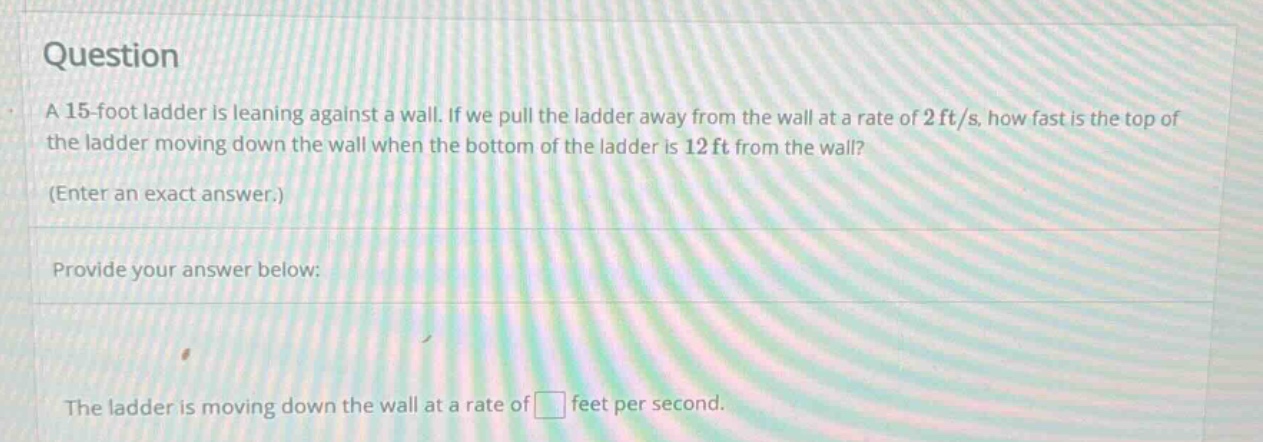
question a 15 - foot ladder is leaning against a wall. if we pull the ladder away from the wall at a rate of 2ft/s, how fast is the top of the ladder moving down the wall when the bottom of the ladder is 12ft from the wall? (enter an exact answer.) provide your answer below: the ladder is moving down the wall at a rate of feet per second.
Answer
Explanation:
Step1: Establish the relationship
Let $x$ be the distance of the bottom of the ladder from the wall and $y$ be the height of the top of the ladder on the wall. By the Pythagorean - theorem, $x^{2}+y^{2}=15^{2}=225$.
Step2: Differentiate with respect to time $t$
Differentiating both sides of the equation $x^{2}+y^{2}=225$ with respect to $t$ gives $2x\frac{dx}{dt}+2y\frac{dy}{dt}=0$. Then we can simplify it to $x\frac{dx}{dt}+y\frac{dy}{dt}=0$.
Step3: Find the value of $y$
When $x = 12$, we can find $y$ using the Pythagorean - theorem: $y=\sqrt{225 - x^{2}}=\sqrt{225 - 144}=\sqrt{81}=9$.
Step4: Substitute the known values
We know that $\frac{dx}{dt}=2$ (the rate at which the bottom of the ladder is moving away from the wall), $x = 12$, and $y = 9$. Substitute these values into the equation $x\frac{dx}{dt}+y\frac{dy}{dt}=0$. We get $12\times2+9\times\frac{dy}{dt}=0$.
Step5: Solve for $\frac{dy}{dt}$
First, simplify the left - hand side of the equation: $24 + 9\times\frac{dy}{dt}=0$. Then, isolate $\frac{dy}{dt}$: $9\times\frac{dy}{dt}=-24$, so $\frac{dy}{dt}=-\frac{24}{9}=-\frac{8}{3}$.
Answer:
$-\frac{8}{3}$