question 16\nmatch each graph with its equation type:\n(ab^x)sin(5x)\nab^x + sin(5x)\nsin(5x)+mx + b\n(mx +…
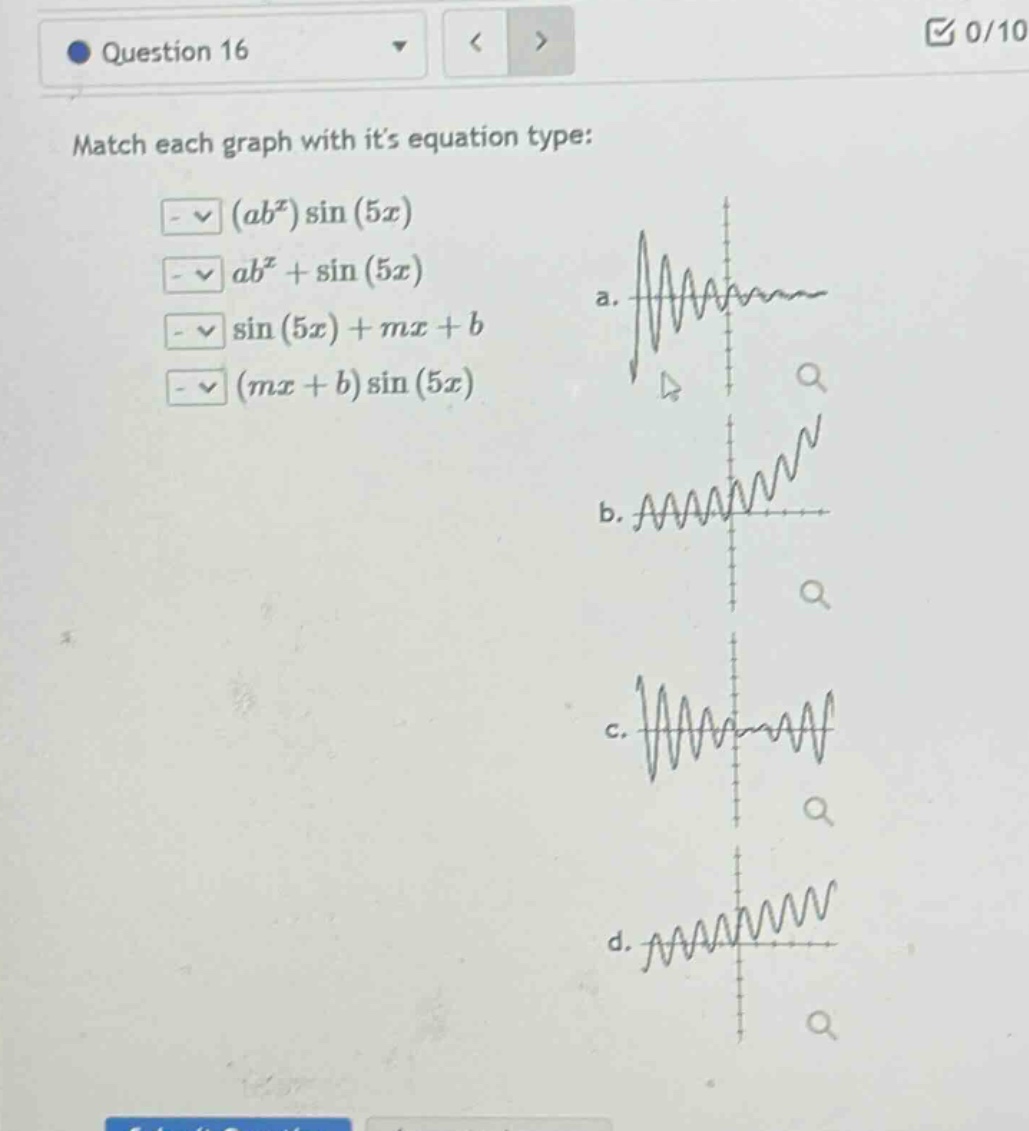
question 16\nmatch each graph with its equation type:\n(ab^x)sin(5x)\nab^x + sin(5x)\nsin(5x)+mx + b\n(mx + b)sin(5x)
Answer
Explanation:
Step1: Analyze $(ab^{x})\sin(5x)$
This is a product of an exponential - function $ab^{x}$ and a sine - function $\sin(5x)$. The amplitude of the sine wave will be multiplied by the value of the exponential function. As $x$ increases (if $b>1$), the amplitude of the sine wave will grow exponentially. Graph a shows a wave with exponentially growing amplitude, so $(ab^{x})\sin(5x)$ matches graph a.
Step2: Analyze $ab^{x}+\sin(5x)$
This is a sum of an exponential function $ab^{x}$ and a sine function $\sin(5x)$. The sine function will oscillate around the exponential function $ab^{x}$. Graph b shows a wave that is centered around an increasing function (the exponential part), so $ab^{x}+\sin(5x)$ matches graph b.
Step3: Analyze $\sin(5x)+mx + b$
This is a sum of a sine function $\sin(5x)$ and a linear function $mx + b$. The sine function will oscillate around the linear function $mx + b$. Graph d shows a wave that is centered around a non - horizontal straight line (the linear part), so $\sin(5x)+mx + b$ matches graph d.
Step4: Analyze $(mx + b)\sin(5x)$
This is a product of a linear function $mx + b$ and a sine function $\sin(5x)$. The amplitude of the sine wave will be multiplied by the value of the linear function. As $x$ changes, the amplitude of the sine wave will change linearly. Graph c shows a wave with linearly changing amplitude, so $(mx + b)\sin(5x)$ matches graph c.
Answer:
$(ab^{x})\sin(5x)$ - a, $ab^{x}+\sin(5x)$ - b, $\sin(5x)+mx + b$ - d, $(mx + b)\sin(5x)$ - c