question 3 of 16. step 1 of 1 correct find the derivative for the given function. write your answer using…
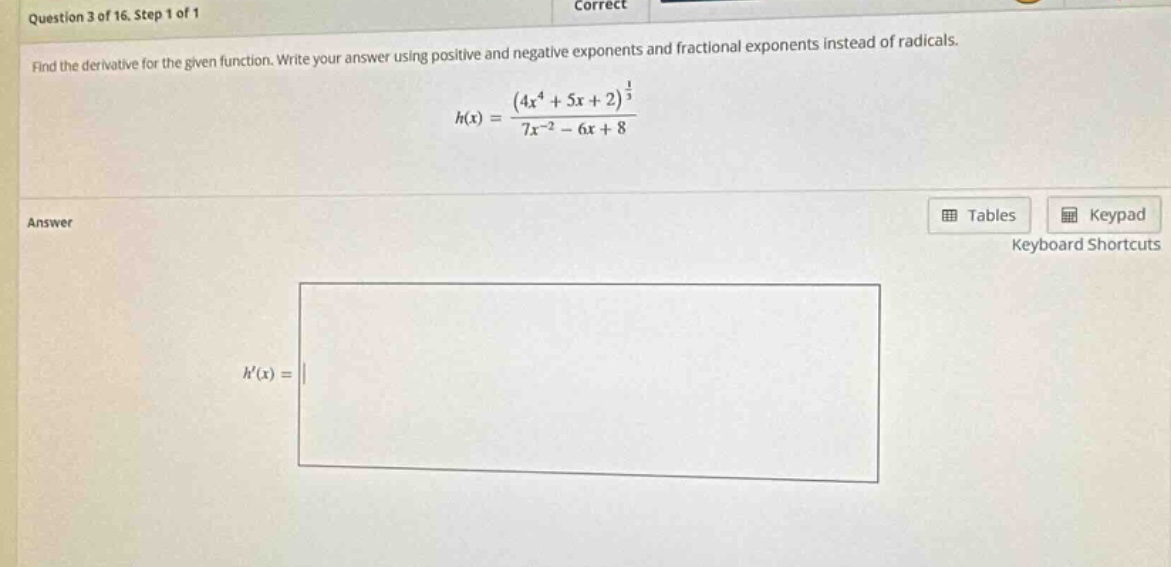
question 3 of 16. step 1 of 1 correct find the derivative for the given function. write your answer using positive and negative exponents and fractional exponents instead of radicals. h(x)=(4x^4 + 5x + 2)^(1/3)/(7x^(-2)-6x + 8) answer h(x)=
Answer
Explanation:
Step1: Apply quotient - rule
The quotient - rule states that if $h(x)=\frac{u(x)}{v(x)}$, then $h^{\prime}(x)=\frac{u^{\prime}(x)v(x)-u(x)v^{\prime}(x)}{v^{2}(x)}$. Here, $u(x)=(4x^{4}+5x + 2)^{\frac{1}{3}}$ and $v(x)=7x^{-2}-6x + 8$.
Step2: Find $u^{\prime}(x)$ using chain - rule
Let $y = u^{\frac{1}{3}}$ where $u = 4x^{4}+5x + 2$. By the chain - rule $\frac{dy}{dx}=\frac{dy}{du}\cdot\frac{du}{dx}$. $\frac{dy}{du}=\frac{1}{3}u^{-\frac{2}{3}}$ and $\frac{du}{dx}=16x^{3}+5$. So, $u^{\prime}(x)=\frac{1}{3}(4x^{4}+5x + 2)^{-\frac{2}{3}}(16x^{3}+5)$.
Step3: Find $v^{\prime}(x)$
Differentiate $v(x)=7x^{-2}-6x + 8$ term - by - term. Using the power rule $\frac{d}{dx}(ax^{n})=nax^{n - 1}$, we get $v^{\prime}(x)=-14x^{-3}-6$.
Step4: Substitute into quotient - rule
[ \begin{align*} h^{\prime}(x)&=\frac{\frac{1}{3}(4x^{4}+5x + 2)^{-\frac{2}{3}}(16x^{3}+5)(7x^{-2}-6x + 8)-(4x^{4}+5x + 2)^{\frac{1}{3}}(-14x^{-3}-6)}{(7x^{-2}-6x + 8)^{2}} \end{align*} ]
Answer:
$\frac{\frac{1}{3}(4x^{4}+5x + 2)^{-\frac{2}{3}}(16x^{3}+5)(7x^{-2}-6x + 8)-(4x^{4}+5x + 2)^{\frac{1}{3}}(-14x^{-3}-6)}{(7x^{-2}-6x + 8)^{2}}$