question 4 of 17 < > - / 1 the figure shows a riemann sum approximation with n subdivisions to ∫a to b f(x)…
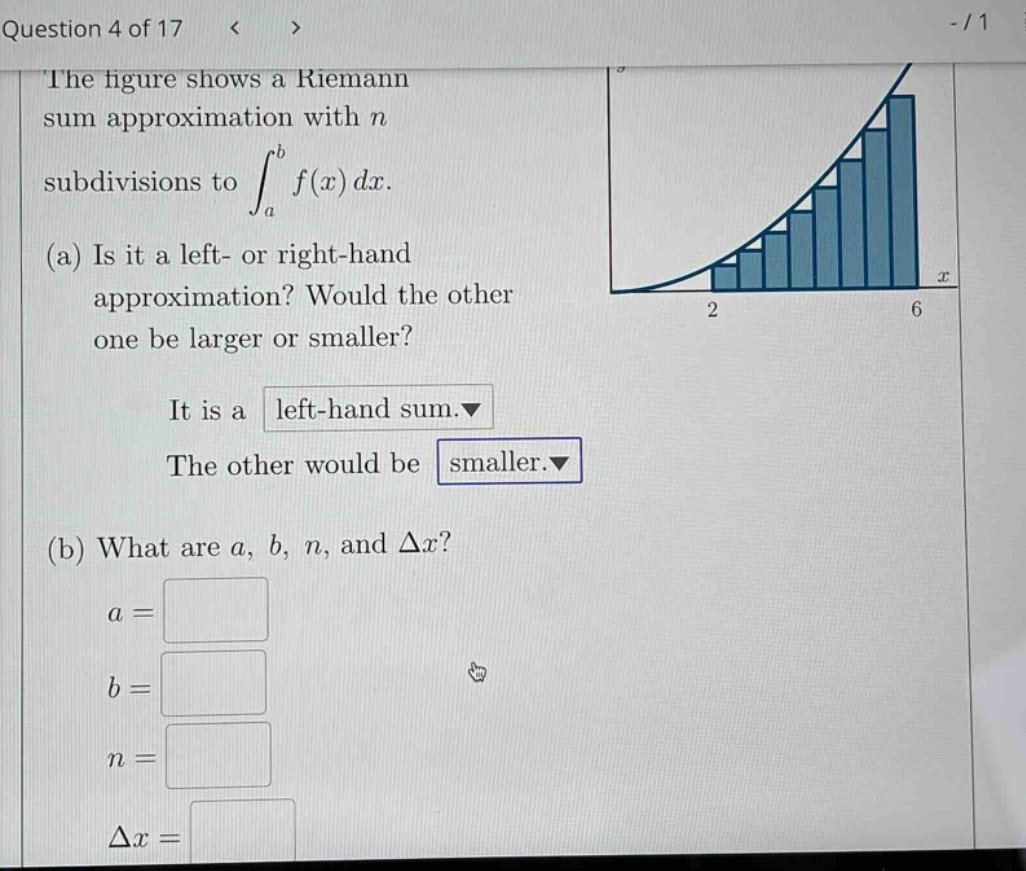
question 4 of 17 < > - / 1 the figure shows a riemann sum approximation with n subdivisions to ∫a to b f(x) dx. (a) is it a left - or right - hand approximation? would the other one be larger or smaller? it is a left - hand sum. the other would be smaller. (b) what are a, b, n, and δx? a = b = n = δx =
Answer
Explanation:
Step1: Identify the lower - limit a
The left - most value of the interval on the x - axis is the lower - limit. From the graph, the left - most x - value is 2, so $a = 2$.
Step2: Identify the upper - limit b
The right - most value of the interval on the x - axis is the upper - limit. From the graph, the right - most x - value is 6, so $b = 6$.
Step3: Count the number of sub - divisions n
Count the number of rectangles. There are 8 rectangles, so $n=8$.
Step4: Calculate $\Delta x$
Use the formula $\Delta x=\frac{b - a}{n}$. Substitute $a = 2$, $b = 6$ and $n = 8$ into the formula: $\Delta x=\frac{6 - 2}{8}=\frac{4}{8}=0.5$.
Answer:
$a = 2$ $b = 6$ $n = 8$ $\Delta x=0.5$