question 33 of 50 2 points use the first derivative test to find the extrema of f(x)=4x³ + 21x² + 36x - 5…
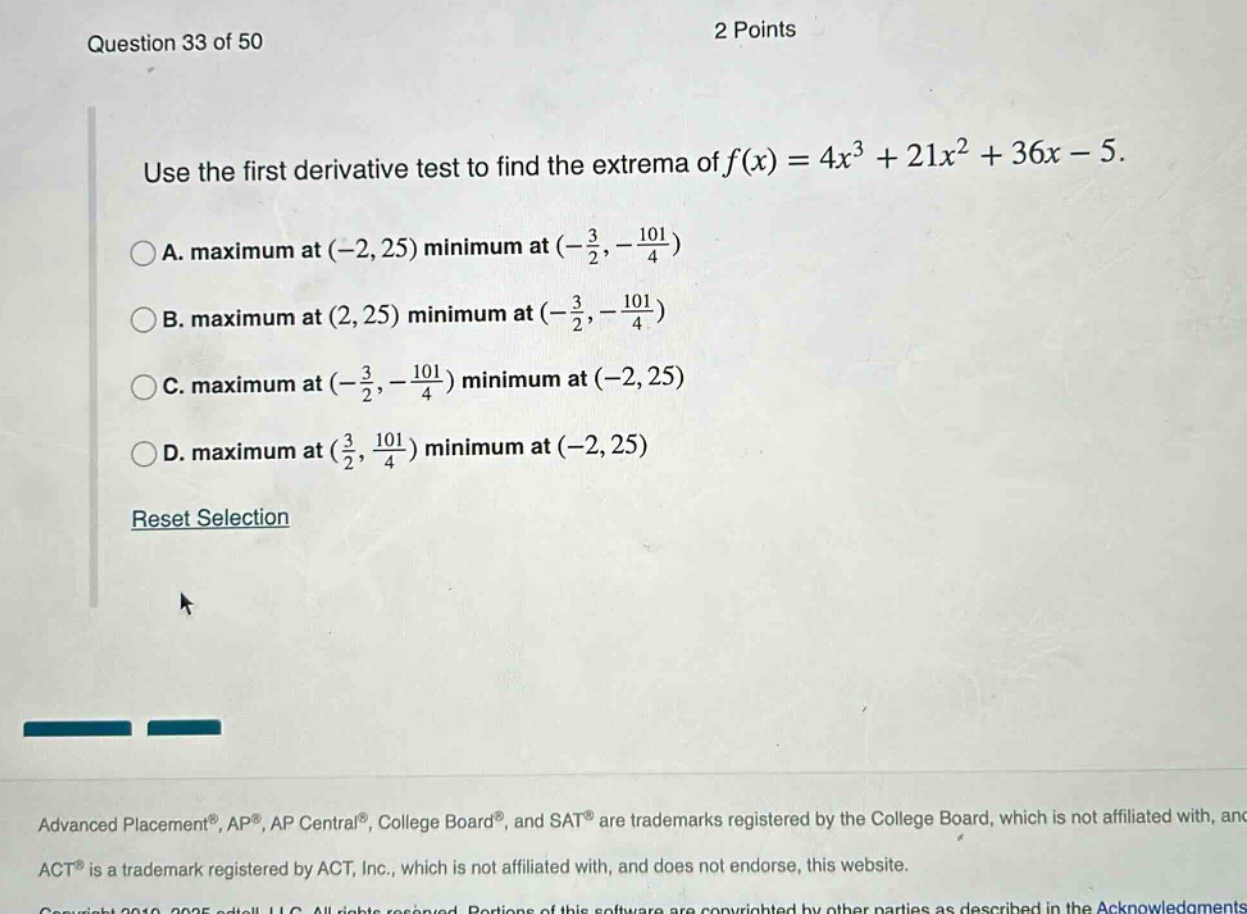
question 33 of 50 2 points use the first derivative test to find the extrema of f(x)=4x³ + 21x² + 36x - 5. a. maximum at (-2,25) minimum at (-3/2,-101/4) b. maximum at (2,25) minimum at (-3/2,-101/4) c. maximum at (-3/2,-101/4) minimum at (-2,25) d. maximum at (3/2,101/4) minimum at (-2,25) reset selection advanced placement®, ap®, ap central®, college board®, and sat® are trademarks registered by the college board, which is not affiliated with, and act® is a trademark registered by act, inc., which is not affiliated with, and does not endorse, this website.
Answer
Explanation:
Step1: Find the first - derivative
Differentiate $f(x)=4x^{3}+21x^{2}+36x - 5$ using the power rule. $f^\prime(x)=12x^{2}+42x + 36$.
Step2: Set the first - derivative equal to zero
$12x^{2}+42x + 36 = 0$. Divide through by 6: $2x^{2}+7x + 6 = 0$. Factor the quadratic: $(2x + 3)(x+2)=0$. Solve for $x$: $x=-2$ or $x =-\frac{3}{2}$.
Step3: Create a sign - chart for $f^\prime(x)$
Choose test points in the intervals $(-\infty,-2)$, $(-2,-\frac{3}{2})$, and $(-\frac{3}{2},\infty)$. Let's choose $x=-3$, $x =-\frac{7}{4}$, and $x = 0$.
- For $x=-3$: $f^\prime(-3)=12\times(-3)^{2}+42\times(-3)+36=108 - 126+36 = 18>0$.
- For $x =-\frac{7}{4}$: $f^\prime(-\frac{7}{4})=12\times(-\frac{7}{4})^{2}+42\times(-\frac{7}{4})+36=\frac{12\times49}{16}-\frac{294}{4}+36=\frac{588}{16}-\frac{1176}{16}+\frac{576}{16}=-\frac{12}{16}<0$.
- For $x = 0$: $f^\prime(0)=36>0$. Since $f^\prime(x)$ changes sign from positive to negative at $x=-2$, $f(x)$ has a local maximum at $x=-2$. $f(-2)=4\times(-2)^{3}+21\times(-2)^{2}+36\times(-2)-5=-32 + 84-72 - 5=-25 + 84=25$. Since $f^\prime(x)$ changes sign from negative to positive at $x=-\frac{3}{2}$, $f(x)$ has a local minimum at $x=-\frac{3}{2}$. $f(-\frac{3}{2})=4\times(-\frac{3}{2})^{3}+21\times(-\frac{3}{2})^{2}+36\times(-\frac{3}{2})-5=4\times(-\frac{27}{8})+21\times\frac{9}{4}-54 - 5=-\frac{27}{2}+\frac{189}{4}-59=\frac{-54 + 189}{4}-59=\frac{135}{4}-59=\frac{135 - 236}{4}=-\frac{101}{4}$.
Answer:
A. maximum at $(-2,25)$ minimum at $(-\frac{3}{2},-\frac{101}{4})$