question 37 (1 point) use the intermediate value theorem to show that there must be a zero for the function…
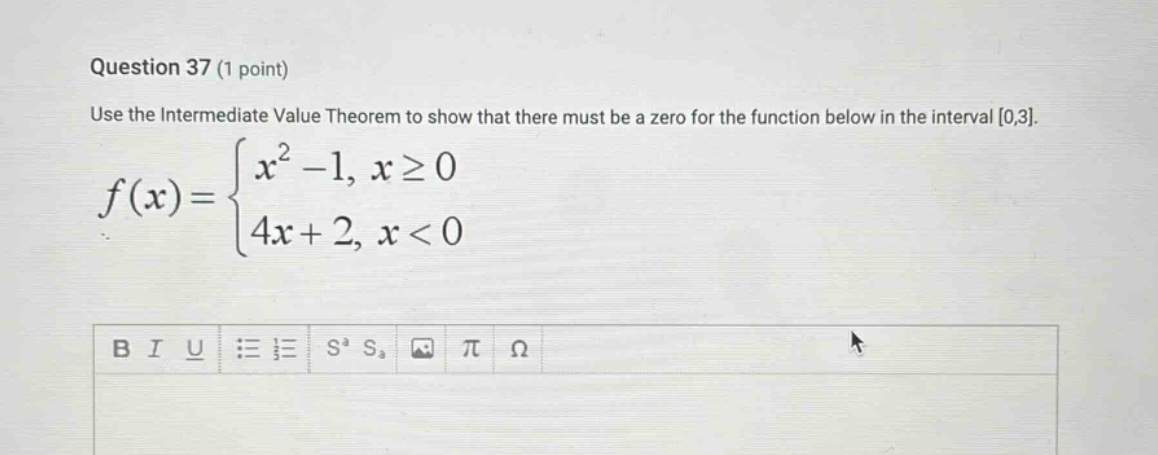
question 37 (1 point) use the intermediate value theorem to show that there must be a zero for the function below in the interval 0,3. f(x) = { x^2 - 1, x ≥ 0; 4x + 2, x < 0 }
Answer
Explanation:
Step1: Evaluate function at left - end of interval
Since (x = 0) and for (x\geq0), (f(x)=x^{2}-1), then (f(0)=0^{2}-1=- 1).
Step2: Evaluate function at right - end of interval
For (x = 3) (and (x\geq0)), (f(3)=3^{2}-1=9 - 1=8).
Step3: Apply Intermediate Value Theorem
The Intermediate Value Theorem states that if (y = f(x)) is continuous on a closed interval ([a,b]), and (k) is a number between (f(a)) and (f(b)), then there exists at least one number (c) in the interval ((a,b)) such that (f(c)=k). Here, the function (y = f(x)) is continuous on ([0,3]) (the two - part function is continuous on their respective domains and at (x = 0) the left - hand limit as (x\to0^{-}) is (4\times0 + 2=2) and the right - hand limit as (x\to0^{+}) is (0^{2}-1=-1), but we are only concerned with the part (x\geq0) on ([0,3])). Since (0) is between (f(0)=-1) and (f(3)=8), there must be a number (c\in(0,3)) such that (f(c)=0).
Answer:
There must be a zero in ([0,3]) as (f(0)=-1), (f(3)=8) and by the Intermediate Value Theorem, since (0) is between (-1) and (8) and (f(x)) is continuous on ([0,3]) (for the relevant part of the piece - wise function on this interval), there exists a (c\in(0,3)) with (f(c)=0).