question 43 of 50 2 points find the vertical asymptotes of the function f(x) = 4(x + 2)(x + 1)(3x + 4)(2x…
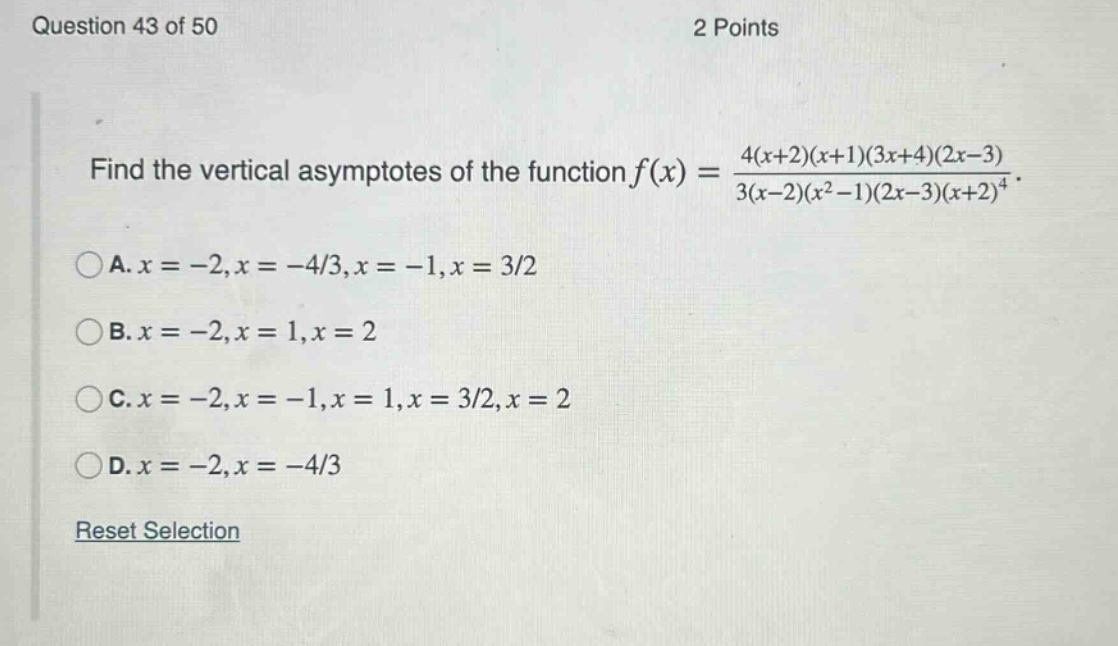
question 43 of 50 2 points find the vertical asymptotes of the function f(x) = 4(x + 2)(x + 1)(3x + 4)(2x - 3)/3(x - 2)(x² - 1)(2x - 3)(x + 2)⁴. a. x = -2,x = -4/3,x = -1,x = 3/2 b. x = -2,x = 1,x = 2 c. x = -2,x = -1,x = 1,x = 3/2,x = 2 d. x = -2,x = -4/3 reset selection
Answer
Explanation:
Step1: Recall vertical - asymptote condition
Vertical asymptotes occur where the denominator of a rational function is zero and the numerator is non - zero. First, factor the denominator completely. The denominator is $3(x - 2)(x^{2}-1)(2x - 3)(x + 2)^{4}=3(x - 2)(x - 1)(x + 1)(2x - 3)(x + 2)^{4}$.
Step2: Set the denominator equal to zero
Set $3(x - 2)(x - 1)(x + 1)(2x - 3)(x + 2)^{4}=0$. Using the zero - product property, we get $x-2 = 0$ or $x - 1=0$ or $x + 1=0$ or $2x-3 = 0$ or $x + 2=0$. Solving these equations: For $x-2 = 0$, we have $x = 2$. For $x - 1=0$, we have $x = 1$. For $x + 1=0$, we have $x=-1$. For $2x-3 = 0$, we have $x=\frac{3}{2}$. For $x + 2=0$, we have $x=-2$. But we need to check if the numerator is non - zero at these values. The numerator is $4(x + 2)(x + 1)(3x + 4)(2x - 3)$. When $x=-2$, the numerator is zero, so $x=-2$ is not a vertical asymptote.
Answer:
C. $x = 1,x = 2,x=-1,x=\frac{3}{2}$