question 7, 4.2.45\npoints: 0 of 1\nthe function ( f(x) ) is continuous on ( (-infty, infty) ). use the…
question 7, 4.2.45\npoints: 0 of 1\nthe function ( f(x) ) is continuous on ( (-infty, infty) ). use the given information to sketch the graph of ( f ).\n\nchoose the correct graph of ( f ) below.
Answer
Explanation:
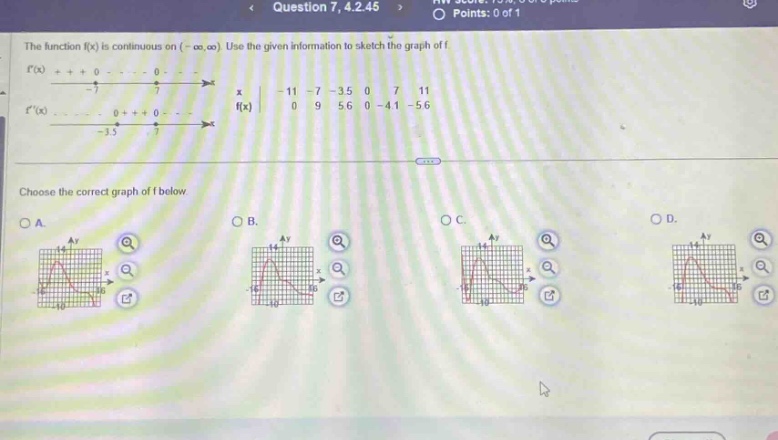
Step1: Analyze the sign of (f^{\prime}(x))
When (f^{\prime}(x)>0), the function (f(x)) is increasing. When (f^{\prime}(x)<0), the function (f(x)) is decreasing. From (f^{\prime}(x)) sign chart: (f(x)) is increasing on ((-\infty, - 7)) (since (f^{\prime}(x)>0) there) and decreasing on ((-7,7)) (since (f^{\prime}(x)<0) there) and decreasing on ((7,\infty)) (since (f^{\prime}(x)<0) there). So (x = - 7) is a local maximum.
Step2: Analyze the sign of (f^{\prime\prime}(x))
When (f^{\prime\prime}(x)>0), the function (f(x)) is concave - up. When (f^{\prime\prime}(x)<0), the function (f(x)) is concave - down. From (f^{\prime\prime}(x)) sign chart: (f(x)) is concave - down on ((-\infty,-3.5)) (since (f^{\prime\prime}(x)<0) there) and concave - up on ((-3.5,7)) (since (f^{\prime\prime}(x)>0) there) and concave - down on ((7,\infty)) (since (f^{\prime\prime}(x)<0) there). So (x=-3.5) is an inflection point.
Step3: Use the function values
We know (f(-11) = 0), (f(-7)=9), (f(0)=0), (f(7)=-41), (f(11)=-56)
Now let's check each option:
- Option A: The function in option A has a local maximum at (x = - 7), an inflection point at (x=-3.5) and passes through the points ((-11,0)), ((-7,9)), ((0,0)), ((7, - 41)), ((11,-56))
Answer:
A.