question attempt: 5 of unlimited use the graph to answer the following questions. (a) over which intervals…
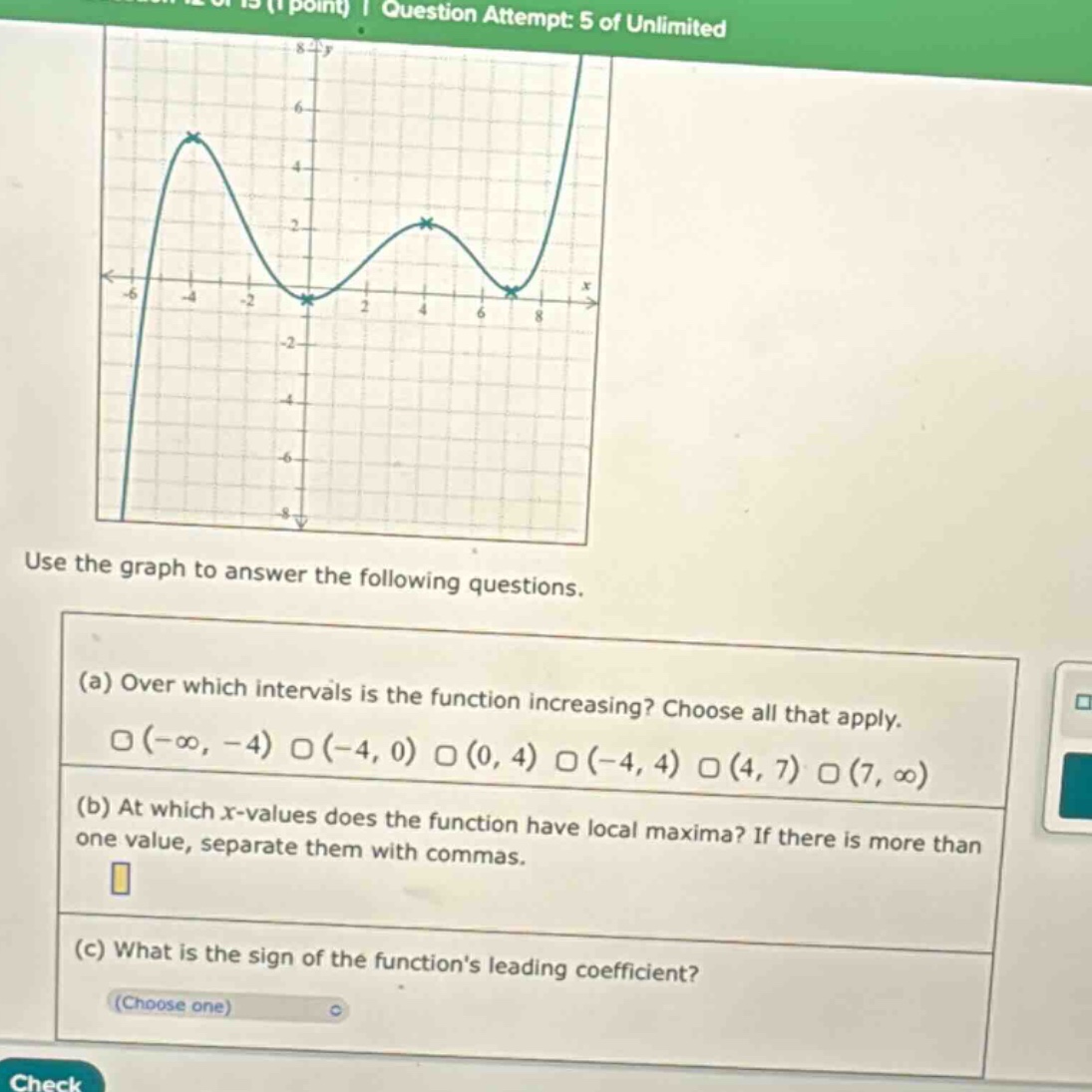
question attempt: 5 of unlimited use the graph to answer the following questions. (a) over which intervals is the function increasing? choose all that apply. (-∞, -4) (-4, 0) (0, 4) (-4, 4) (4, 7) (7, ∞) (b) at which x - values does the function have local maxima? if there is more than one value, separate them with commas. (c) what is the sign of the functions leading coefficient? (choose one)
Answer
Explanation:
Step1: Identify increasing intervals
A function is increasing when the graph goes up as we move from left - to - right. From the graph, the function is increasing on the intervals $(-\infty,-4)$ and $(0,4)$ and $(7,\infty)$.
Step2: Find local maxima
Local maxima occur at points where the function changes from increasing to decreasing. From the graph, the local maxima occur at $x=-4$ and $x = 4$.
Step3: Determine leading - coefficient sign
Since the graph of the function goes up on the far - left and far - right (as $x\to-\infty,y\to\infty$ and as $x\to\infty,y\to\infty$), the leading coefficient of the polynomial function is positive.
Answer:
(a) $(-\infty,-4),(0,4),(7,\infty)$ (b) $-4,4$ (c) Positive