question the base of a triangle is shrinking at a rate of 5 cm/s and the height of the triangle is…
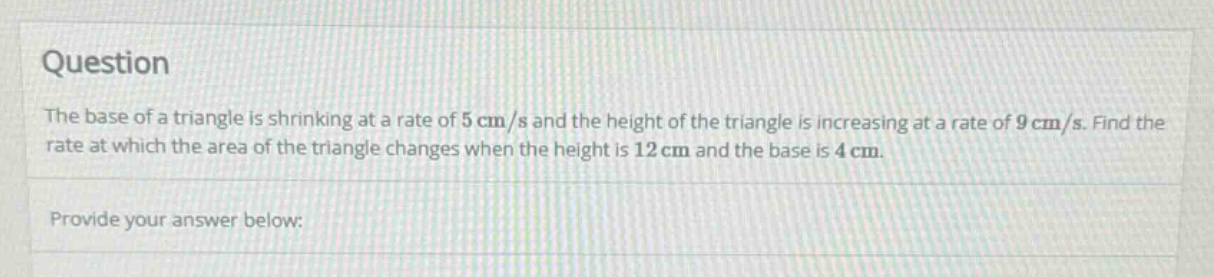
question the base of a triangle is shrinking at a rate of 5 cm/s and the height of the triangle is increasing at a rate of 9 cm/s. find the rate at which the area of the triangle changes when the height is 12 cm and the base is 4 cm. provide your answer below:
Answer
Explanation:
Step1: Recall area formula
The area formula of a triangle is $A=\frac{1}{2}bh$, where $b$ is the base and $h$ is the height.
Step2: Differentiate with respect to time $t$
Using the product - rule $(uv)^\prime = u^\prime v+uv^\prime$, where $u = \frac{1}{2}b$ and $v = h$. So $\frac{dA}{dt}=\frac{1}{2}(\frac{db}{dt}h + b\frac{dh}{dt})$.
Step3: Substitute given values
We know that $\frac{db}{dt}=- 5$ cm/s (negative because the base is shrinking), $\frac{dh}{dt}=9$ cm/s, $b = 4$ cm and $h = 12$ cm. Substitute these values into the formula: $\frac{dA}{dt}=\frac{1}{2}((-5)\times12 + 4\times9)$. First, calculate $(-5)\times12=-60$ and $4\times9 = 36$. Then $(-60)+36=-24$. So $\frac{dA}{dt}=\frac{1}{2}\times(-24)=-12$ cm²/s.
Answer:
$-12$ cm²/s