question 5 - no calculator let f be a continuous function on the closed interval -2,6 such that f(-2)=4 and…
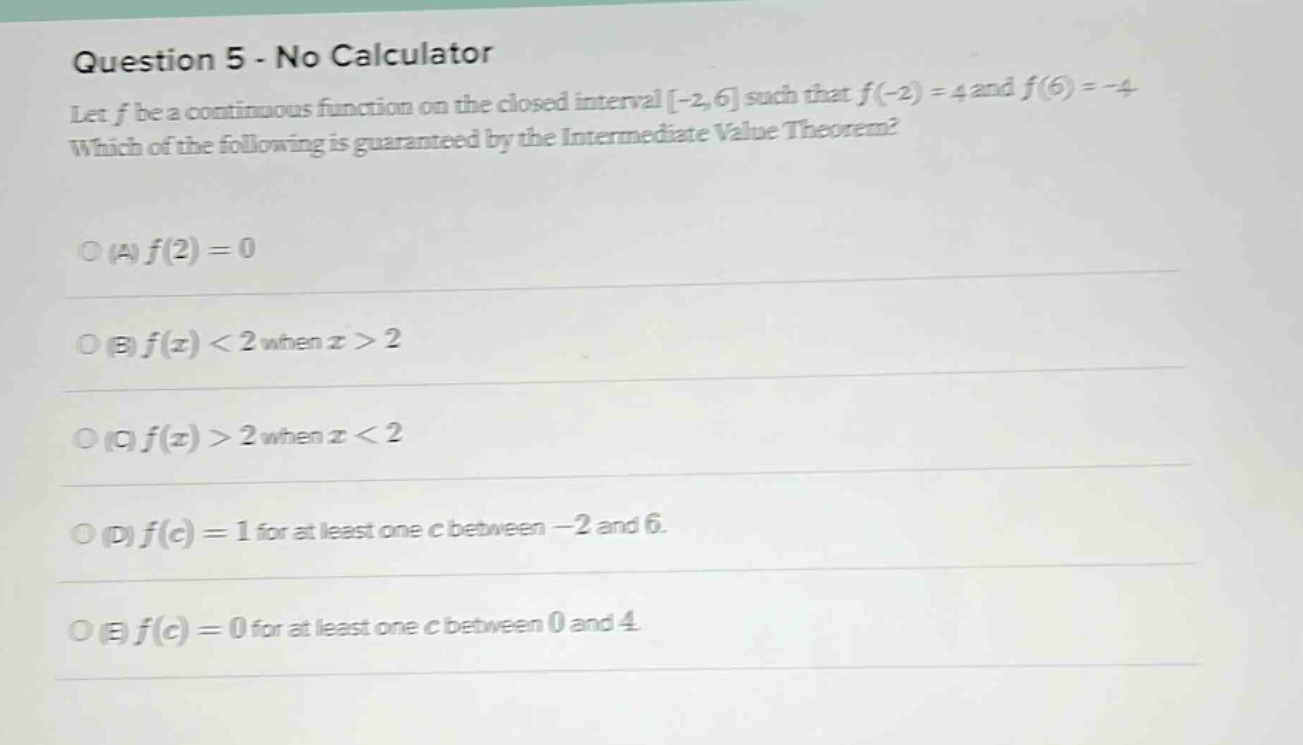
question 5 - no calculator let f be a continuous function on the closed interval -2,6 such that f(-2)=4 and f(6)= - 4. which of the following is guaranteed by the intermediate value theorem? (a) f(2)=0 (b) f(x)<2 when x>2 (c) f(x)>2 when x<2 (d) f(c)=1 for at least one c between -2 and 6. (e) f(c)=0 for at least one c between 0 and 4.
Answer
Explanation:
Step1: Recall Intermediate Value Theorem
If (y = f(x)) is continuous on ([a,b]), and (k) is a number between (f(a)) and (f(b)), then there exists at least one number (c) in ((a,b)) such that (f(c)=k). Here (a=-2), (b = 6), (f(-2)=4) and (f(6)=-4).
Step2: Analyze each option
- Option A: There is no guarantee (f(2)=0).
- Option B: We cannot say (f(x)<2) when (x > 2) from the given information.
- Option C: We cannot say (f(x)>2) when (x < 2) from the given information.
- Option D: Since (1) is between (- 4) and (4), by the Intermediate - Value Theorem, there exists at least one (c\in(-2,6)) such that (f(c)=1).
- Option E: The interval ((0,4)) is not the relevant interval ((-2,6)) for applying the theorem with the given (f(-2)) and (f(6)) values.
Answer:
D. (f(c)=1) for at least one (c) between (-2) and (6)