question 4 - no calculator. if k ≠ 0, then lim(x→k) (x² + 3x - kx - 3k)/(x² - k²) is (a) (k + 3)/2k (b) (k…
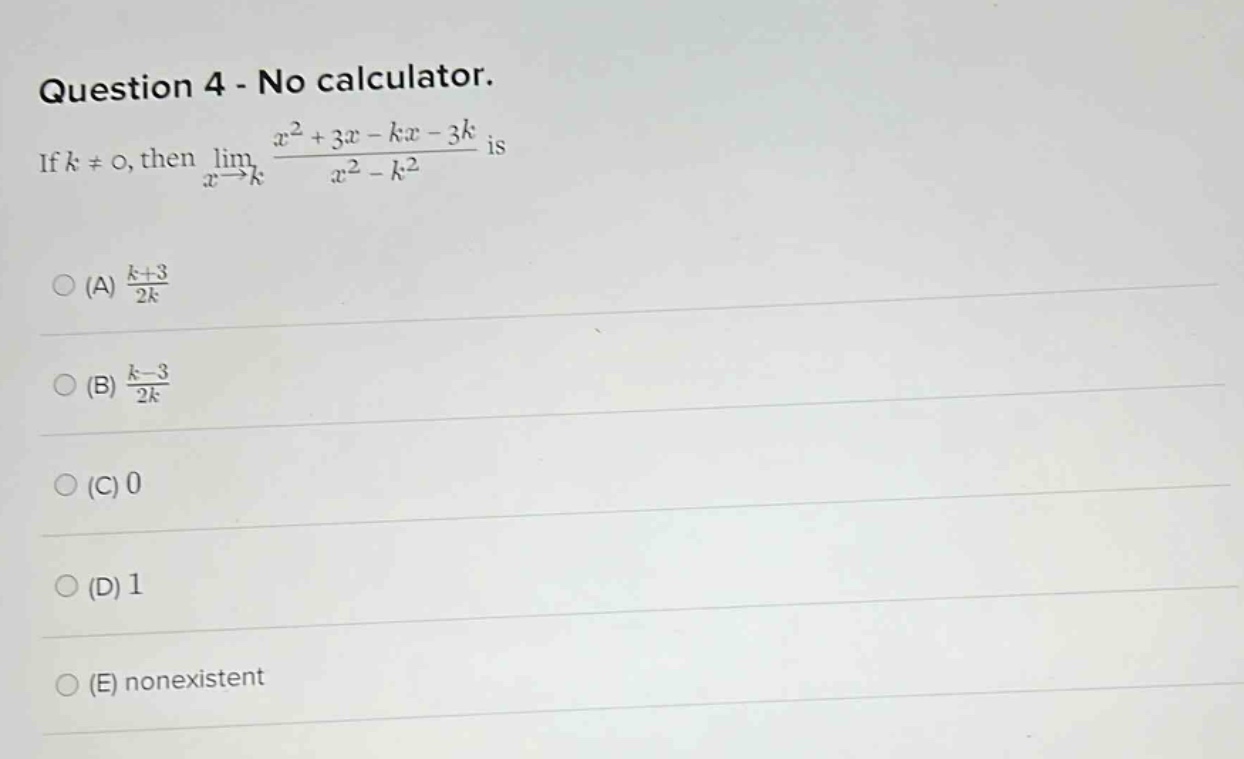
question 4 - no calculator. if k ≠ 0, then lim(x→k) (x² + 3x - kx - 3k)/(x² - k²) is (a) (k + 3)/2k (b) (k - 3)/2k (c) 0 (d) 1 (e) nonexistent
Answer
Explanation:
Step1: Factor the numerator and denominator
Factor the numerator $x^{2}+3x - kx - 3k$: $x^{2}+3x - kx - 3k=x(x + 3)-k(x + 3)=(x + 3)(x - k)$ Factor the denominator $x^{2}-k^{2}$ using the difference - of - squares formula $a^{2}-b^{2}=(a + b)(a - b)$, so $x^{2}-k^{2}=(x + k)(x - k)$
Step2: Simplify the rational function
$\lim_{x\rightarrow k}\frac{x^{2}+3x - kx - 3k}{x^{2}-k^{2}}=\lim_{x\rightarrow k}\frac{(x + 3)(x - k)}{(x + k)(x - k)}$ Since $x\neq k$ (we are taking the limit as $x$ approaches $k$), we can cancel out the common factor $(x - k)$: $\lim_{x\rightarrow k}\frac{(x + 3)(x - k)}{(x + k)(x - k)}=\lim_{x\rightarrow k}\frac{x + 3}{x + k}$
Step3: Evaluate the limit
Substitute $x = k$ into $\frac{x + 3}{x + k}$: $\frac{k+3}{k + k}=\frac{k + 3}{2k}$
Answer:
A. $\frac{k + 3}{2k}$