question 7 - no calculator. the table above gives values of continuous functions f and g and their values at…
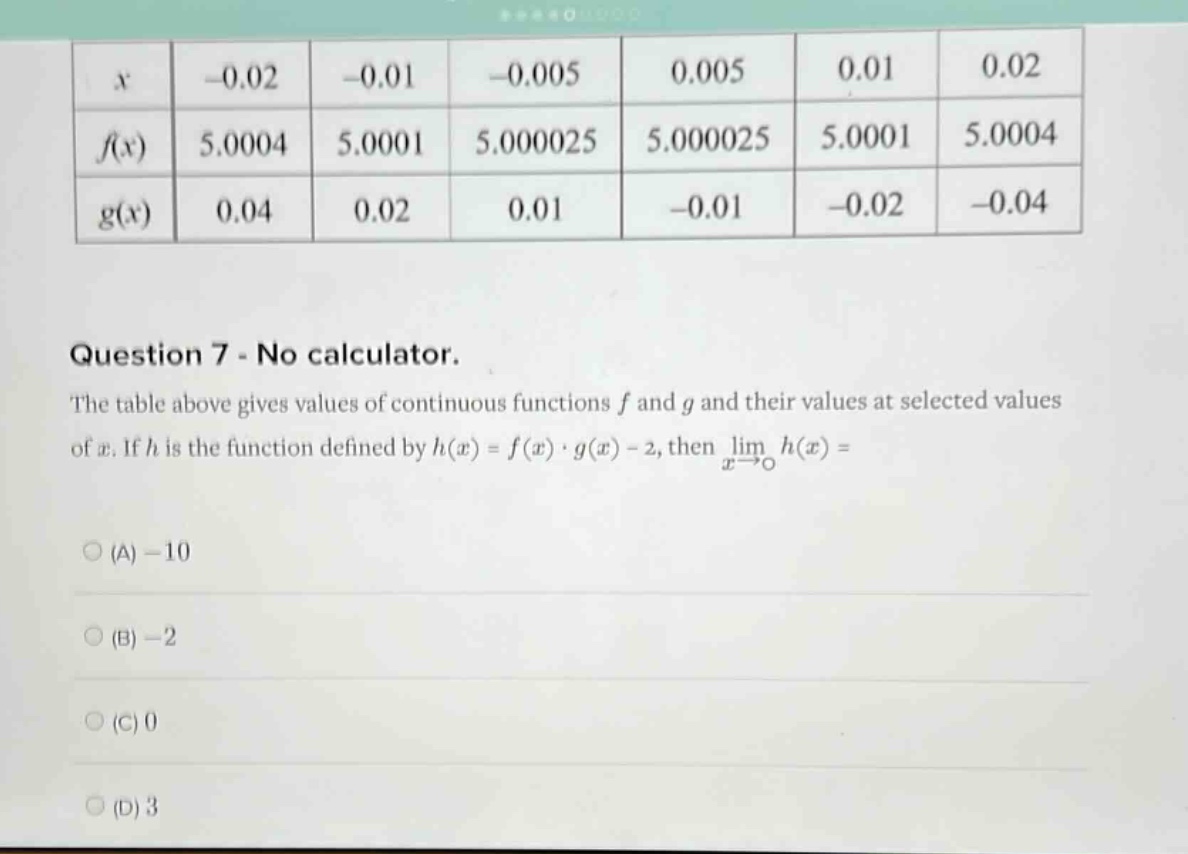
question 7 - no calculator. the table above gives values of continuous functions f and g and their values at selected values of x. if h is the function defined by h(x)=f(x)·g(x)-2, then lim x→0 h(x)= (a) -10 (b) -2 (c) 0 (d) 3
Answer
Explanation:
Step1: Recall limit - product rule
If (f(x)) and (g(x)) are continuous functions, (\lim_{x\rightarrow a}(f(x)\cdot g(x))=\lim_{x\rightarrow a}f(x)\cdot\lim_{x\rightarrow a}g(x)) and (\lim_{x\rightarrow a}(f(x)+ c)=\lim_{x\rightarrow a}f(x)+c) for a constant (c). Here (h(x)=f(x)\cdot g(x)-2), so (\lim_{x\rightarrow0}h(x)=\lim_{x\rightarrow0}(f(x)\cdot g(x)) - 2).
Step2: Find (\lim_{x\rightarrow0}f(x)) and (\lim_{x\rightarrow0}g(x))
As (x) approaches (0) from the left ((x=-0.02,-0.01,-0.005)) and from the right ((x = 0.005,0.01,0.02)), (f(x)) approaches (5) (since (f(-0.02)=5.0004), (f(-0.01)=5.0001), (f(-0.005)=5.000025), (f(0.005)=5.000025), (f(0.01)=5.0001), (f(0.02)=5.0004)), so (\lim_{x\rightarrow0}f(x)=5). As (x) approaches (0) from the left ((x=-0.02,-0.01,-0.005)) and from the right ((x = 0.005,0.01,0.02)), (g(x)) approaches (0) (since (g(-0.02)=0.04), (g(-0.01)=0.02), (g(-0.005)=0.01), (g(0.005)=-0.01), (g(0.01)=-0.02), (g(0.02)=-0.04)), so (\lim_{x\rightarrow0}g(x)=0).
Step3: Calculate (\lim_{x\rightarrow0}h(x))
Using the limit - product rule (\lim_{x\rightarrow0}(f(x)\cdot g(x))=\lim_{x\rightarrow0}f(x)\cdot\lim_{x\rightarrow0}g(x)=5\times0 = 0). Then (\lim_{x\rightarrow0}h(x)=\lim_{x\rightarrow0}(f(x)\cdot g(x))-2=0 - 2=-2).
Answer:
B. (-2)