question 2 of 5\ndescribe the end - behavior of the function below.\n$f(x)=4(2)^{(-x)}-3$\nas x approaches…
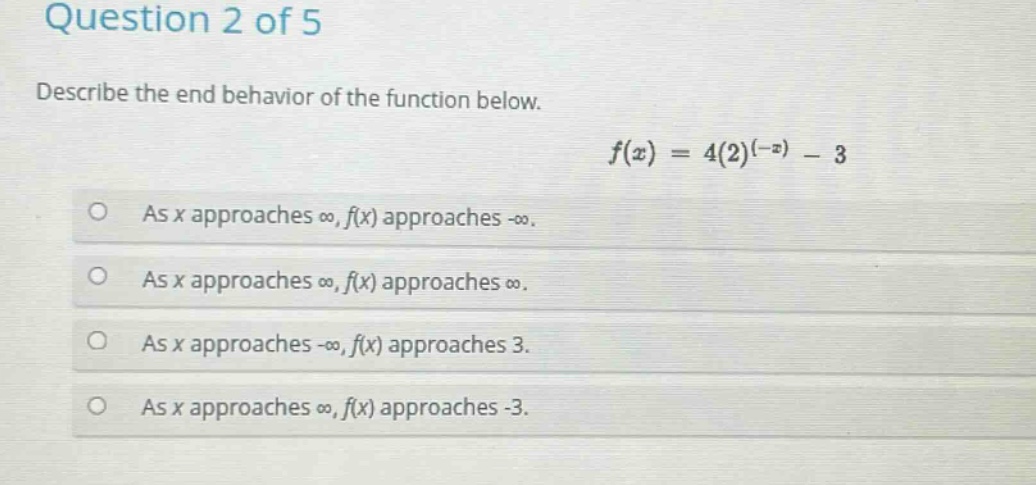
question 2 of 5\ndescribe the end - behavior of the function below.\n$f(x)=4(2)^{(-x)}-3$\nas x approaches ∞, f(x) approaches -∞.\nas x approaches ∞, f(x) approaches ∞.\nas x approaches -∞, f(x) approaches 3.\nas x approaches ∞, f(x) approaches -3.
Answer
Explanation:
Step1: Analyze as $x\to\infty$
We have $f(x)=4(2)^{-x}-3 = 4\left(\frac{1}{2}\right)^{x}-3$. As $x\to\infty$, the term $\left(\frac{1}{2}\right)^{x}\to0$ since for an exponential function $y = a^{x}$ where $0 < a<1$, as $x$ gets larger, $y$ gets closer to 0. So $f(x)=4\left(\frac{1}{2}\right)^{x}-3\to - 3$ as $x\to\infty$.
Step2: Analyze as $x\to-\infty$
As $x\to-\infty$, the term $\left(\frac{1}{2}\right)^{x}=2^{|x|}\to\infty$. So $f(x)=4\left(\frac{1}{2}\right)^{x}-3\to\infty$ as $x\to-\infty$.
Answer:
As $x$ approaches $\infty$, $f(x)$ approaches $-3$.