this question is designed to be answered with a calculator. region $r$ is bounded by $y = \\frac{1}{2}\\cos(\…
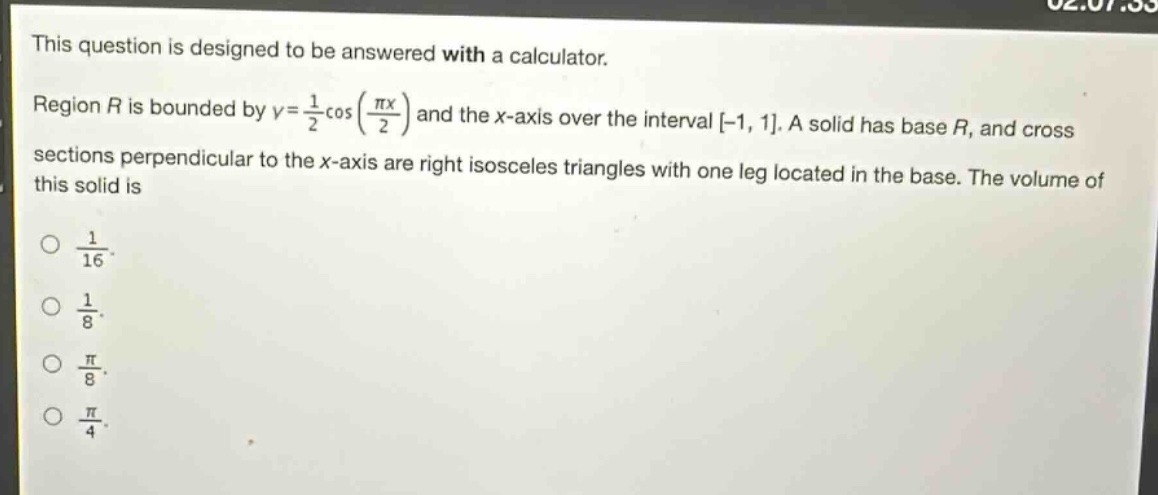
this question is designed to be answered with a calculator. region $r$ is bounded by $y = \\frac{1}{2}\\cos(\\frac{\\pi x}{2})$ and the $x$-axis over the interval $-1, 1$. a solid has base $r$, and cross - sections perpendicular to the $x$-axis are right isosceles triangles with one leg located in the base. the volume of this solid is\n$\\frac{1}{16}$.\n$\\frac{1}{8}$.\n$\\frac{\\pi}{8}$.\n$\\frac{\\pi}{4}$.
Answer
Explanation:
Step1: Recall volume formula
The volume $V$ of a solid with cross - sectional area $A(x)$ over the interval $[a,b]$ is given by $V=\int_{a}^{b}A(x)dx$.
Step2: Find the area of the cross - section
For a right isosceles triangle with one leg $l$ located in the base, the area of the right isosceles triangle $A(x)=\frac{1}{2}l^{2}$. Here, $l = y=\frac{1}{2}\cos(\frac{\pi x}{2})$, so $A(x)=\frac{1}{2}(\frac{1}{2}\cos(\frac{\pi x}{2}))^{2}=\frac{1}{8}\cos^{2}(\frac{\pi x}{2})$.
Step3: Use the double - angle formula
Recall that $\cos^{2}\theta=\frac{1 + \cos(2\theta)}{2}$. So, $\cos^{2}(\frac{\pi x}{2})=\frac{1+\cos(\pi x)}{2}$, and $A(x)=\frac{1}{16}(1 + \cos(\pi x))$.
Step4: Calculate the volume integral
We want to find the volume over the interval $[-1,1]$, so $V=\int_{-1}^{1}\frac{1}{16}(1+\cos(\pi x))dx$. Since $\int_{-1}^{1}\frac{1}{16}dx=\frac{1}{16}x\big|{-1}^{1}=\frac{1}{16}(1-(-1))=\frac{1}{8}$ and $\int{-1}^{1}\frac{1}{16}\cos(\pi x)dx$. Let $u = \pi x$, $du=\pi dx$. When $x=-1$, $u =-\pi$; when $x = 1$, $u=\pi$. Then $\int_{-1}^{1}\frac{1}{16}\cos(\pi x)dx=\frac{1}{16\pi}\int_{-\pi}^{\pi}\cos(u)du$. Since $\int_{-\pi}^{\pi}\cos(u)du=\sin(u)\big|_{-\pi}^{\pi}=0$, so $V=\frac{1}{8}+0=\frac{1}{8}$.
Answer:
$\frac{1}{8}$