this question is designed to be answered without a calculator. the base of a solid is bounded by x² + y² =…
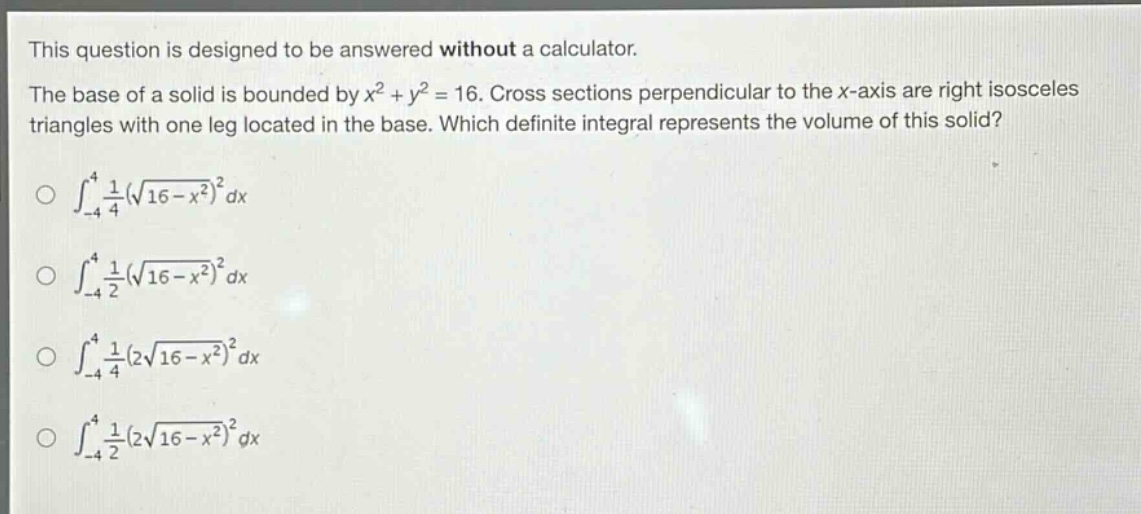
this question is designed to be answered without a calculator. the base of a solid is bounded by x² + y² = 16. cross sections perpendicular to the x - axis are right isosceles triangles with one leg located in the base. which definite integral represents the volume of this solid? ∫-4,4 1/4(√(16 - x²))² dx ∫-4,4 1/2(√(16 - x²))² dx ∫-4,4 1/4(2√(16 - x²))² dx ∫-4,4 1/2(2√(16 - x²))² dx
Answer
Explanation:
Step1: Rewrite the circle equation
The equation $x^{2}+y^{2}=16$ can be rewritten as $y = \pm\sqrt{16 - x^{2}}$. The length of the base of each right - isosceles triangle cross - section perpendicular to the $x$ - axis is $b = 2\sqrt{16 - x^{2}}$ (distance between $y=\sqrt{16 - x^{2}}$ and $y =-\sqrt{16 - x^{2}}$).
Step2: Find the area of the cross - section
For a right - isosceles triangle, if one leg has length $l$, the area formula is $A=\frac{1}{2}l^{2}$. Here, $l$ (one leg of the right - isosceles triangle) is equal to the base of the triangle, so $A(x)=\frac{1}{2}(2\sqrt{16 - x^{2}})^{2}$.
Step3: Determine the limits of integration
The circle $x^{2}+y^{2}=16$ has $x$ values ranging from $x=-4$ to $x = 4$.
Step4: Set up the volume integral
The volume $V$ of the solid with cross - sectional area $A(x)$ from $x=a$ to $x = b$ is given by $V=\int_{a}^{b}A(x)dx$. So, $V=\int_{-4}^{4}\frac{1}{2}(2\sqrt{16 - x^{2}})^{2}dx$.
Answer:
$\int_{-4}^{4}\frac{1}{2}(2\sqrt{16 - x^{2}})^{2}dx$