this question is designed to be answered without a calculator. which statement best describes lim xe^x? x→…
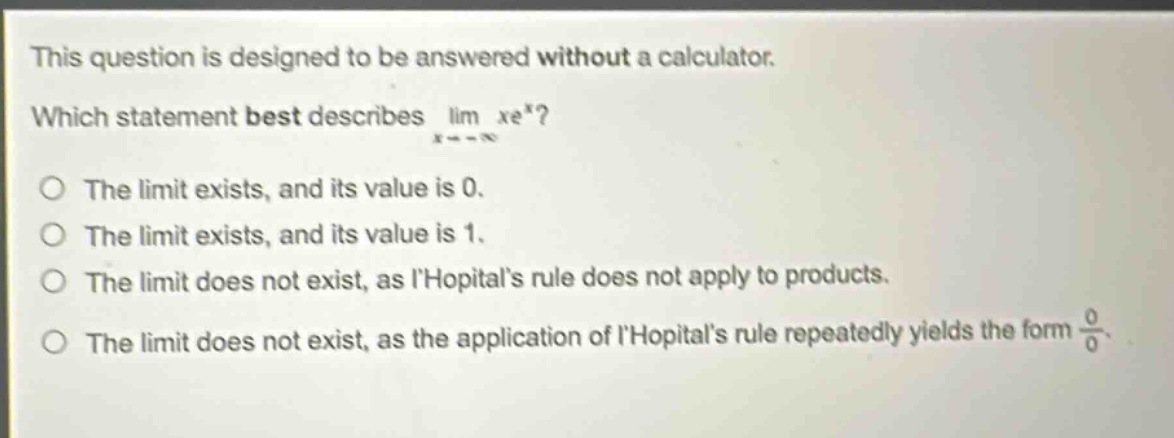
this question is designed to be answered without a calculator. which statement best describes lim xe^x? x→ -∞ the limit exists, and its value is 0. the limit exists, and its value is 1. the limit does not exist, as lhopitals rule does not apply to products. the limit does not exist, as the application of lhopitals rule repeatedly yields the form 0/0.
Answer
Answer:
The limit exists, and its value is 0.
Explanation:
Step1: Rewrite the limit
We have $\lim_{x\rightarrow-\infty}xe^{x}=\lim_{x\rightarrow-\infty}\frac{x}{e^{-x}}$.
Step2: Apply L'Hopital's rule
As $x\rightarrow-\infty$, we have the indeterminate form $\frac{-\infty}{\infty}$. By L'Hopital's rule, $\lim_{x\rightarrow-\infty}\frac{x}{e^{-x}}=\lim_{x\rightarrow-\infty}\frac{1}{-e^{-x}}$.
Step3: Evaluate the new - limit
As $x\rightarrow-\infty$, $e^{-x}\rightarrow\infty$. So, $\lim_{x\rightarrow-\infty}\frac{1}{-e^{-x}} = 0$.