this question is designed to be answered without a calculator. use the three functions shown. i. $f(x)=0.1(x…
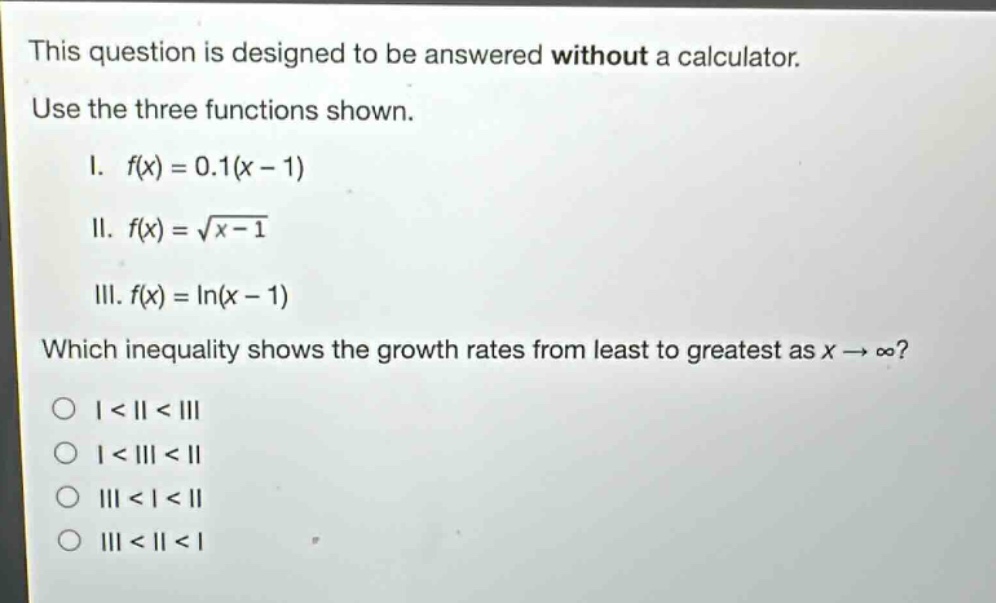
this question is designed to be answered without a calculator. use the three functions shown. i. $f(x)=0.1(x - 1)$ ii. $f(x)=sqrt{x - 1}$ iii. $f(x)=ln(x - 1)$ which inequality shows the growth rates from least to greatest as $x\rightarrowinfty$? o i < ii < iii o i < iii < ii o iii < i < ii o iii < ii < i
Answer
Explanation:
Step1: Recall growth - rate rules
For large - value of (x), the growth rate of linear functions (y = ax + b) ((a>0)), square - root functions (y=\sqrt{x}), and logarithmic functions (y = \ln x) follow a certain order. The general rule is that logarithmic functions grow slower than square - root functions, and square - root functions grow slower than linear functions as (x\to\infty).
Step2: Analyze function I
Function (f(x)=0.1(x - 1)=0.1x-0.1) is a linear function. The slope (a = 0.1>0), and as (x\to\infty), the value of (f(x)) increases linearly.
Step3: Analyze function II
Function (f(x)=\sqrt{x - 1}) is a square - root function. As (x\to\infty), the function value increases, but at a slower rate compared to a linear function.
Step4: Analyze function III
Function (f(x)=\ln(x - 1)) is a logarithmic function. As (x\to\infty), the function value increases, but it has the slowest growth rate among the three types of functions considered here.
Answer:
III < II < I