question determine if the function below has a horizontal or a slant asymptote, and explain why. f(x)=(-1…
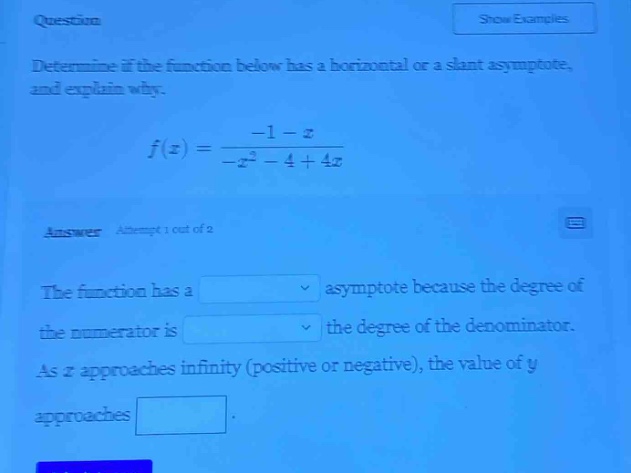
question determine if the function below has a horizontal or a slant asymptote, and explain why. f(x)=(-1 - x)/(-x^2 - 4 + 4x) answer attempt 1 out of 2 the function has a asymptote because the degree of the numerator is the degree of the denominator. as x approaches infinity (positive or negative), the value of y approaches
Answer
Explanation:
Step1: Identify degrees of numerator and denominator
The numerator $-1 - x$ has degree 1 (highest - power of $x$ is 1), and the denominator $-x^{2}-4 + 4x$ has degree 2 (highest - power of $x$ is 2).
Step2: Determine the type of asymptote
Since the degree of the numerator ($n = 1$) is less than the degree of the denominator ($m=2$), the function has a horizontal asymptote.
Step3: Find the horizontal - asymptote value
For a rational function $y=\frac{a_nx^n+\cdots+a_0}{b_mx^m+\cdots + b_0}$ with $n\lt m$, as $x\to\pm\infty$, $y\to0$.
Answer:
The function has a horizontal asymptote because the degree of the numerator is less than the degree of the denominator. As $x$ approaches infinity (positive or negative), the value of $y$ approaches $0$.