question\ndetermine if the function below has a horizontal or a slant asymptote, and explain why.\n…
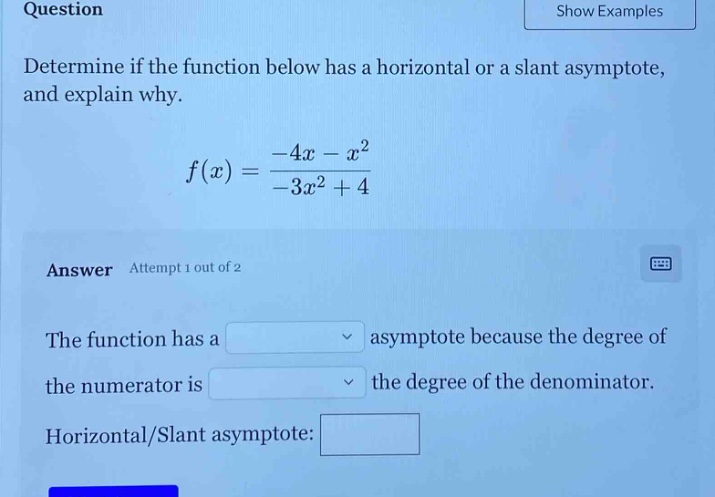
question\ndetermine if the function below has a horizontal or a slant asymptote, and explain why.\n f(x)=\frac{-4x - x^{2}}{-3x^{2}+4} \nanswer attempt 1 out of 2\nthe function has a asymptote because the degree of the numerator is the degree of the denominator.\nhorizontal/slant asymptote:
Answer
Explanation:
Step1: Identify degrees of numerator and denominator
The numerator $-4x - x^{2}$ has degree 2 (highest - power of $x$ is 2), and the denominator $-3x^{2}+4$ has degree 2.
Step2: Recall asymptote rules
When the degree of the numerator $n$ and the degree of the denominator $m$ are equal ($n = m$), the function $y=\frac{f(x)}{g(x)}$ has a horizontal asymptote $y=\frac{a_{n}}{b_{m}}$, where $a_{n}$ and $b_{m}$ are the leading coefficients of the numerator and denominator respectively. Here, $a_{n}=-1$ and $b_{m}=-3$.
Step3: Calculate horizontal asymptote
The horizontal asymptote is $y = \frac{-1}{-3}=\frac{1}{3}$.
Answer:
The function has a horizontal asymptote because the degree of the numerator is equal to the degree of the denominator. Horizontal/Slant asymptote: $y=\frac{1}{3}$