question evaluate the integral ∫_{e^4}^∞ 5 / (x(ln x)^2) dx or state that the integral diverges. answer…
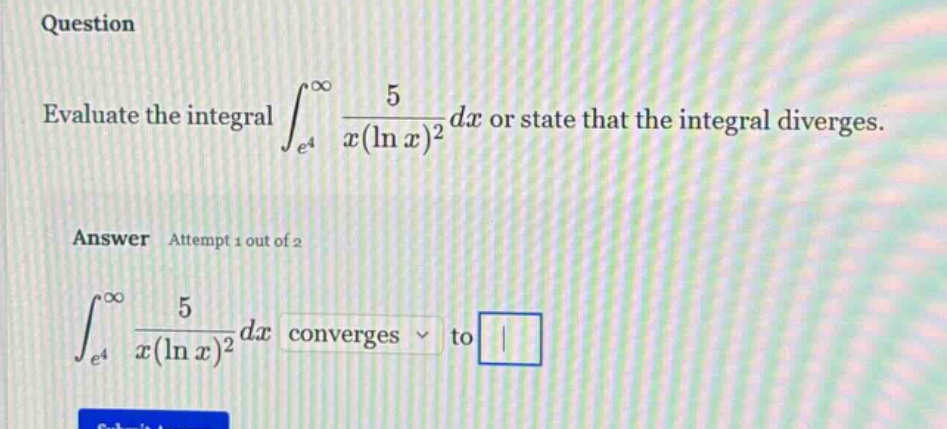
question evaluate the integral ∫_{e^4}^∞ 5 / (x(ln x)^2) dx or state that the integral diverges. answer attempt 1 out of 2 ∫_{e^4}^∞ 5 / (x(ln x)^2) dx converges to
Answer
Explanation:
Step1: Use substitution
Let $u = \ln x$, then $du=\frac{1}{x}dx$. When $x = e^{4}$, $u=\ln(e^{4}) = 4$. As $x\to\infty$, $u\to\infty$. The integral $\int_{e^{4}}^{\infty}\frac{5}{x(\ln x)^{2}}dx$ becomes $5\int_{4}^{\infty}\frac{1}{u^{2}}du$.
Step2: Rewrite the integral as a limit
$5\int_{4}^{\infty}\frac{1}{u^{2}}du=5\lim_{b\to\infty}\int_{4}^{b}u^{- 2}du$.
Step3: Integrate $u^{-2}$
Using the power - rule for integration $\int x^{n}dx=\frac{x^{n + 1}}{n+1}+C$ ($n\neq - 1$), we have $\int u^{-2}du=-\frac{1}{u}+C$. Then $5\lim_{b\to\infty}\int_{4}^{b}u^{-2}du = 5\lim_{b\to\infty}\left[-\frac{1}{u}\right]_{4}^{b}$.
Step4: Evaluate the limit
$5\lim_{b\to\infty}\left(-\frac{1}{b}+\frac{1}{4}\right)$. As $b\to\infty$, $\lim_{b\to\infty}-\frac{1}{b}=0$. So $5\lim_{b\to\infty}\left(-\frac{1}{b}+\frac{1}{4}\right)=5\times\frac{1}{4}=\frac{5}{4}$.
Answer:
$\frac{5}{4}$