question evaluate the integral below. ∫tan⁻¹(4x)dx be sure to place the argument of any inverse…
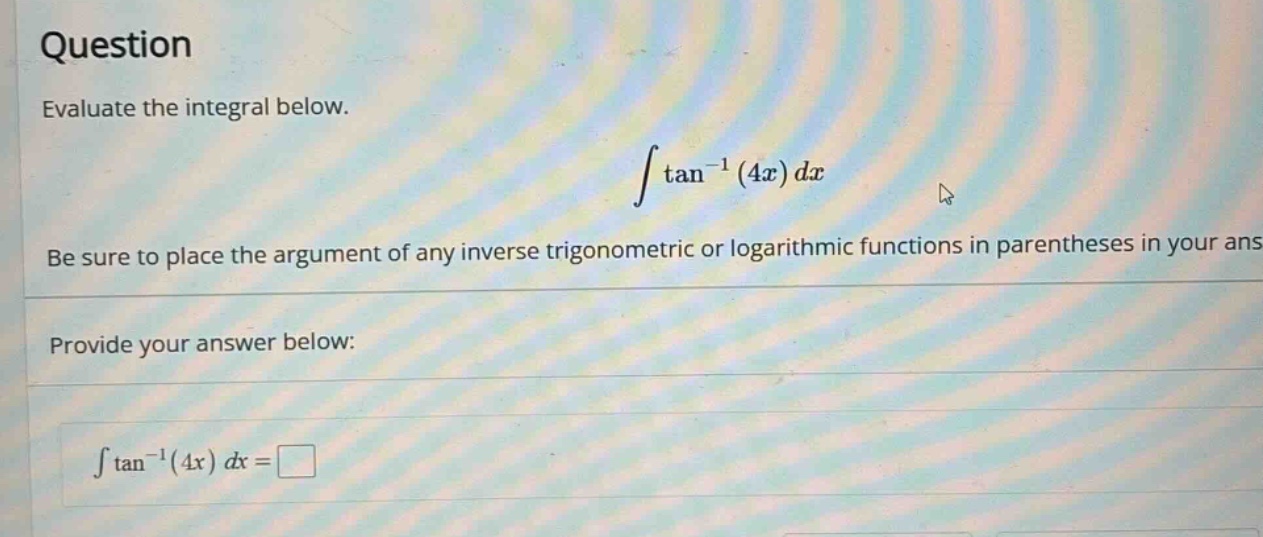
question evaluate the integral below. ∫tan⁻¹(4x)dx be sure to place the argument of any inverse trigonometric or logarithmic functions in parentheses in your ans provide your answer below: ∫tan⁻¹(4x)dx =
Answer
Explanation:
Step1: Use integration - by - parts formula
The integration - by - parts formula is $\int u;dv=uv-\int v;du$. Let $u = \tan^{- 1}(4x)$ and $dv=dx$. Then $du=\frac{4}{1 + 16x^{2}}dx$ and $v=x$.
Step2: Apply the formula
$\int\tan^{-1}(4x)dx=x\tan^{-1}(4x)-\int\frac{4x}{1 + 16x^{2}}dx$.
Step3: Solve the new integral
Let $t = 1+16x^{2}$, then $dt = 32x;dx$ and $x;dx=\frac{1}{32}dt$. So $\int\frac{4x}{1 + 16x^{2}}dx=\frac{4}{32}\int\frac{dt}{t}=\frac{1}{8}\ln|t|+C=\frac{1}{8}\ln(1 + 16x^{2})+C$.
Answer:
$x\tan^{-1}(4x)-\frac{1}{8}\ln(1 + 16x^{2})+C$