question find the area bounded by y = -x + 5, y = √(x + 1) and the x - axis. submit your answer in…
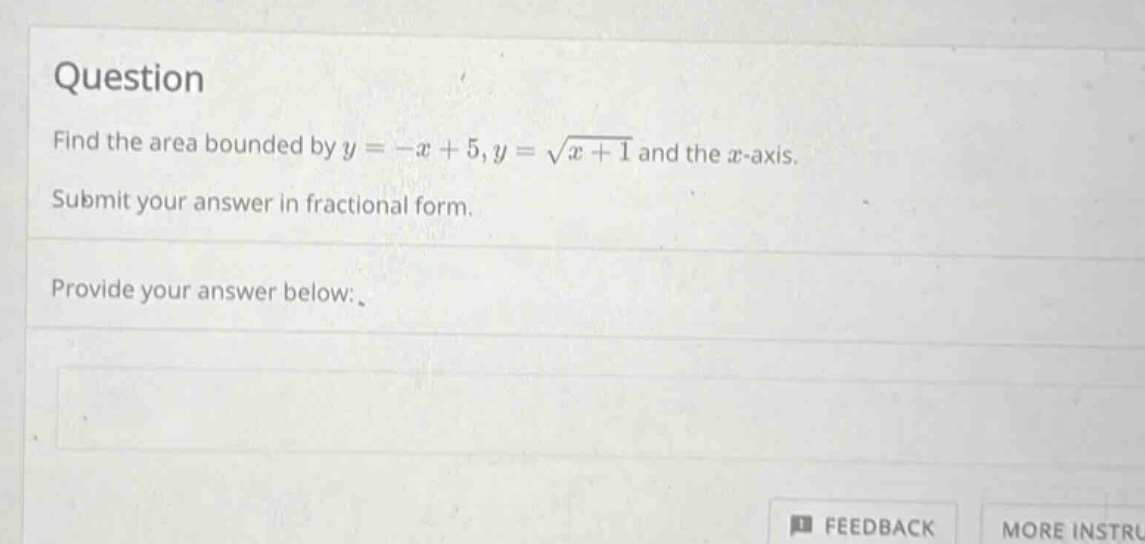
question find the area bounded by y = -x + 5, y = √(x + 1) and the x - axis. submit your answer in fractional form. provide your answer below:
Answer
Explanation:
Step1: Find intersection points
First, find where $y = \sqrt{x + 1}$ intersects the $x$-axis. Set $y=0$, then $0=\sqrt{x + 1}$, so $x=-1$. Next, find the intersection of $y=-x + 5$ and $y = \sqrt{x+1}$. Square both sides of $-x + 5=\sqrt{x + 1}$ to get $(-x + 5)^2=x + 1$, which expands to $x^{2}-10x + 25=x + 1$, or $x^{2}-11x+24 = 0$. Factoring gives $(x - 3)(x - 8)=0$, so $x = 3$ or $x = 8$. We take $x = 3$ since for $x = 8$, $-x+5=-3$ and $\sqrt{x + 1}=3$ and we are looking for non - negative $y$ values for the area with the $x$-axis. Also, find where $y=-x + 5$ intersects the $x$-axis. Set $y = 0$, then $x = 5$.
Step2: Set up integral for area
The area $A$ is given by the sum of two integrals. The first integral is from $x=-1$ to $x = 3$ for the function $y=\sqrt{x + 1}$ and the second integral is from $x = 3$ to $x = 5$ for the function $y=-x + 5$. So $A=\int_{-1}^{3}\sqrt{x + 1}dx+\int_{3}^{5}(-x + 5)dx$.
Step3: Evaluate first integral
Let $u=x + 1$, $du=dx$. When $x=-1$, $u = 0$; when $x = 3$, $u = 4$. Then $\int_{-1}^{3}\sqrt{x + 1}dx=\int_{0}^{4}u^{\frac{1}{2}}du=\left[\frac{2}{3}u^{\frac{3}{2}}\right]_{0}^{4}=\frac{2}{3}(4)^{\frac{3}{2}}=\frac{2}{3}\times8=\frac{16}{3}$.
Step4: Evaluate second integral
$\int_{3}^{5}(-x + 5)dx=\left[-\frac{1}{2}x^{2}+5x\right]_{3}^{5}=(-\frac{1}{2}(5)^{2}+5\times5)-(-\frac{1}{2}(3)^{2}+5\times3)=(-\frac{25}{2}+25)-(-\frac{9}{2}+15)=\frac{25}{2}-\frac{21}{2}=2$.
Step5: Calculate total area
$A=\frac{16}{3}+2=\frac{16 + 6}{3}=\frac{22}{3}$.
Answer:
$\frac{22}{3}$