question\nfind the area bounded by y = e, y = e^x and y = e^(-x).\nprovide your answer below:_
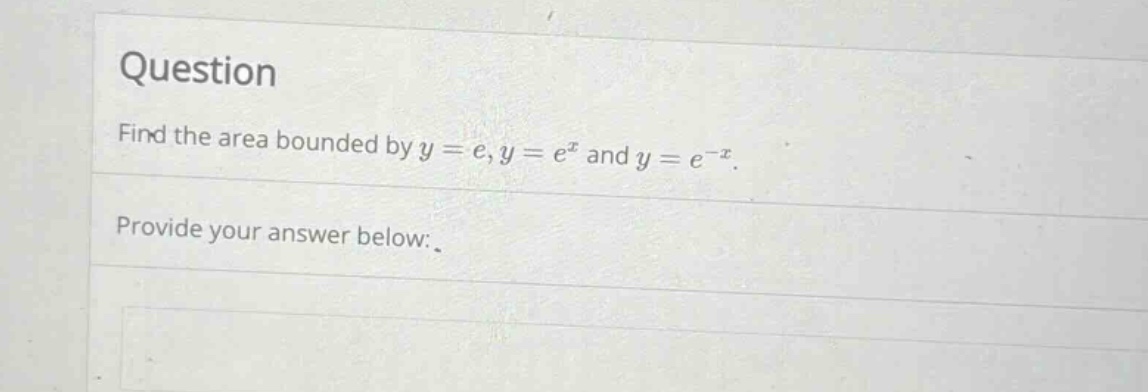
question\nfind the area bounded by y = e, y = e^x and y = e^(-x).\nprovide your answer below:_
Answer
Explanation:
Step1: Find intersection points
First, find the intersection of $y = e$ and $y=e^{x}$. Set $e = e^{x}$, then $x = 1$. Find the intersection of $y = e$ and $y=e^{-x}$. Set $e=e^{-x}$, then $x=- 1$.
Step2: Set up the integral for area
The area $A$ between the curves is given by the integral $A=\int_{-1}^{1}(e - e^{-x})dx+\int_{1}^{0}(e - e^{x})dx$. We can also use the symmetry of the region about the y - axis. The area $A = 2\int_{0}^{1}(e - e^{x})dx$.
Step3: Evaluate the integral
We know that $\int(e - e^{x})dx=ex - e^{x}+C$. Evaluating the definite - integral: [ \begin{align*} 2\int_{0}^{1}(e - e^{x})dx&=2\left[(ex - e^{x})\big|_{0}^{1}\right]\ &=2\left[(e\times1 - e^{1})-(e\times0 - e^{0})\right]\ &=2\left[(e - e)-(0 - 1)\right]\ &=2\times1\ &=2 \end{align*} ]
Answer:
$2$