question\nfind the first five non - zero terms of the maclaurin series for cos(4x) and then use that to…
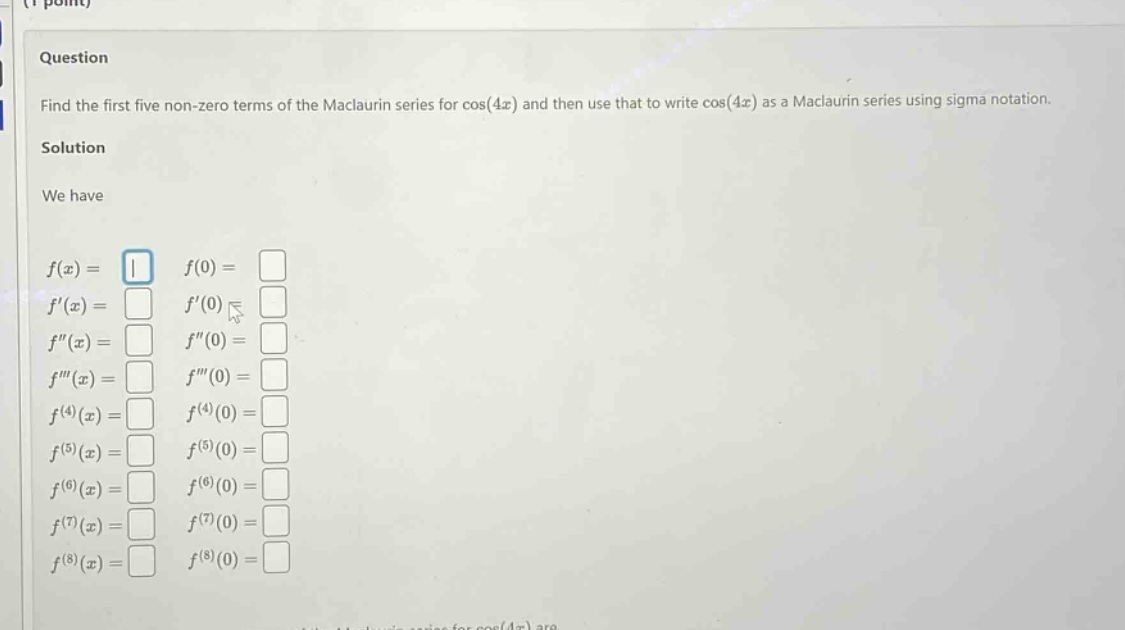
question\nfind the first five non - zero terms of the maclaurin series for cos(4x) and then use that to write cos(4x) as a maclaurin series using sigma notation.\nsolution\nwe have\nf(x) = \nf(0) =\nf(x) = \nf(0) =\nf(x) = \nf(0) =\nf(x) = \nf(0) =\nf^(4)(x) = \nf^(4)(0) =\nf^(5)(x) = \nf^(5)(0) =\nf^(6)(x) = \nf^(6)(0) =\nf^(7)(x) = \nf^(7)(0) =\nf^(8)(x) = \nf^(8)(0) =
Answer
Explanation:
Step1: Recall Maclaurin - series formula
The Maclaurin series of a function (f(x)) is given by (f(x)=\sum_{n = 0}^{\infty}\frac{f^{(n)}(0)}{n!}x^{n}=f(0)+f^{\prime}(0)x+\frac{f^{\prime\prime}(0)}{2!}x^{2}+\frac{f^{\prime\prime\prime}(0)}{3!}x^{3}+\cdots), where (f^{(n)}(x)) is the (n) - th derivative of (f(x)). Let (f(x)=\cos(4x)).
Step2: Find the first - few derivatives and their values at (x = 0)
- (f(x)=\cos(4x)), then (f(0)=\cos(0)=1).
- (f^{\prime}(x)=-4\sin(4x)), so (f^{\prime}(0)=-4\sin(0)=0).
- (f^{\prime\prime}(x)=-16\cos(4x)), then (f^{\prime\prime}(0)=-16\cos(0)=-16).
- (f^{\prime\prime\prime}(x)=64\sin(4x)), so (f^{\prime\prime\prime}(0)=64\sin(0)=0).
- (f^{(4)}(x)=256\cos(4x)), then (f^{(4)}(0)=256\cos(0)=256).
- (f^{(5)}(x)=-1024\sin(4x)), so (f^{(5)}(0)=-1024\sin(0)=0).
- (f^{(6)}(x)=-4096\cos(4x)), then (f^{(6)}(0)=-4096\cos(0)=-4096).
- (f^{(7)}(x)=16384\sin(4x)), so (f^{(7)}(0)=16384\sin(0)=0).
- (f^{(8)}(x)=65536\cos(4x)), then (f^{(8)}(0)=65536\cos(0)=65536).
Step3: Write the first five non - zero terms of the Maclaurin series
The Maclaurin series terms are: (f(0) = 1), (\frac{f^{\prime\prime}(0)}{2!}x^{2}=\frac{-16}{2}x^{2}=-8x^{2}), (\frac{f^{(4)}(0)}{4!}x^{4}=\frac{256}{24}x^{4}=\frac{32}{3}x^{4}), (\frac{f^{(6)}(0)}{6!}x^{6}=\frac{-4096}{720}x^{6}=-\frac{256}{45}x^{6}), (\frac{f^{(8)}(0)}{8!}x^{8}=\frac{65536}{40320}x^{8}=\frac{256}{315}x^{8}). So the first five non - zero terms are (1 - 8x^{2}+\frac{32}{3}x^{4}-\frac{256}{45}x^{6}+\frac{256}{315}x^{8}).
Step4: Write the Maclaurin series in sigma notation
We know that the general form of the Maclaurin series for (\cos(4x)) is (\sum_{n = 0}^{\infty}\frac{(-1)^{n}(4x)^{2n}}{(2n)!}).
Answer:
The first five non - zero terms: (1 - 8x^{2}+\frac{32}{3}x^{4}-\frac{256}{45}x^{6}+\frac{256}{315}x^{8}); Sigma notation: (\sum_{n = 0}^{\infty}\frac{(-1)^{n}(4x)^{2n}}{(2n)!})