question the functions f(x), g(x), and h(x) are shown below. select the option that represents the ordering…
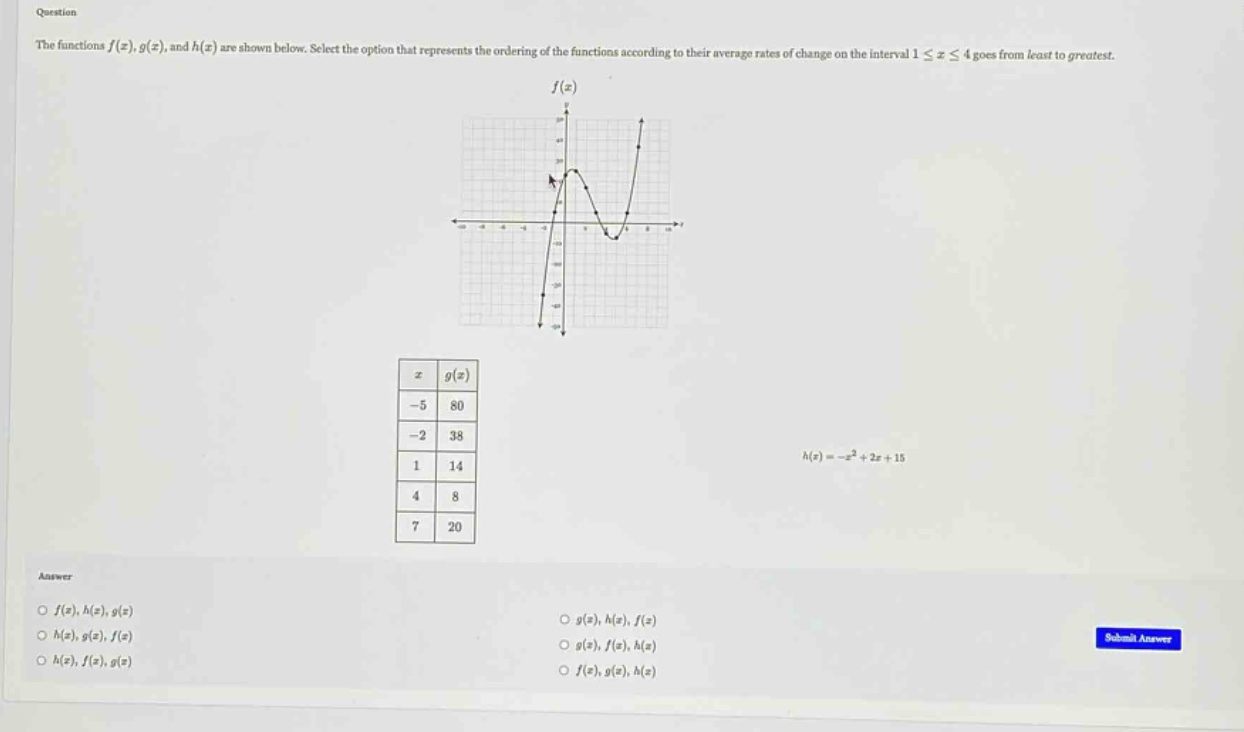
question the functions f(x), g(x), and h(x) are shown below. select the option that represents the ordering of the functions according to their average rates of change on the interval 1 ≤ x ≤ 4 goes from least to greatest. answer o f(x), h(x), g(x) o h(x), g(x), f(x) o h(x), f(x), g(x) o g(x), h(x), f(x) o g(x), f(x), h(x) o f(x), g(x), h(x) submit answer
Answer
Explanation:
Step1: Recall average - rate - of - change formula
The average rate of change of a function $y = k(x)$ on the interval $[a,b]$ is $\frac{k(b)-k(a)}{b - a}$.
Step2: Calculate average rate of change of $f(x)$
From the graph of $f(x)$, when $x = 1$, assume $f(1)=y_1$ and when $x = 4$, assume $f(4)=y_2$. By counting the grid - points, if we assume each grid - square has side - length 1, we find the change in $y$ and change in $x$. Let's say $f(1)\approx10$ and $f(4)\approx30$. Then the average rate of change of $f(x)$ on $[1,4]$ is $\frac{f(4)-f(1)}{4 - 1}=\frac{30 - 10}{3}=\frac{20}{3}\approx6.67$.
Step3: Calculate average rate of change of $g(x)$
We know that $g(x)$ has values $g(1) = 14$ and $g(4)=8$. Using the average rate of change formula $\frac{g(4)-g(1)}{4 - 1}=\frac{8 - 14}{3}=\frac{-6}{3}=-2$.
Step4: Calculate average rate of change of $h(x)$
Given $h(x)=-x^{2}+2x + 15$. First, find $h(1)$ and $h(4)$. $h(1)=-1^{2}+2\times1 + 15=-1 + 2+15 = 16$. $h(4)=-4^{2}+2\times4 + 15=-16 + 8+15 = 7$. The average rate of change of $h(x)$ on $[1,4]$ is $\frac{h(4)-h(1)}{4 - 1}=\frac{7 - 16}{3}=\frac{-9}{3}=-3$.
Step5: Order the average rates of change
Comparing the average rates of change: $-3<-2<\frac{20}{3}$, so $h(x),g(x),f(x)$.
Answer:
$h(x),g(x),f(x)$