question 7 given the function, find the following: f(x)=-√(x + 2)+3 a = -1 h = -2 k = 3 endpoint (-2,3) max…
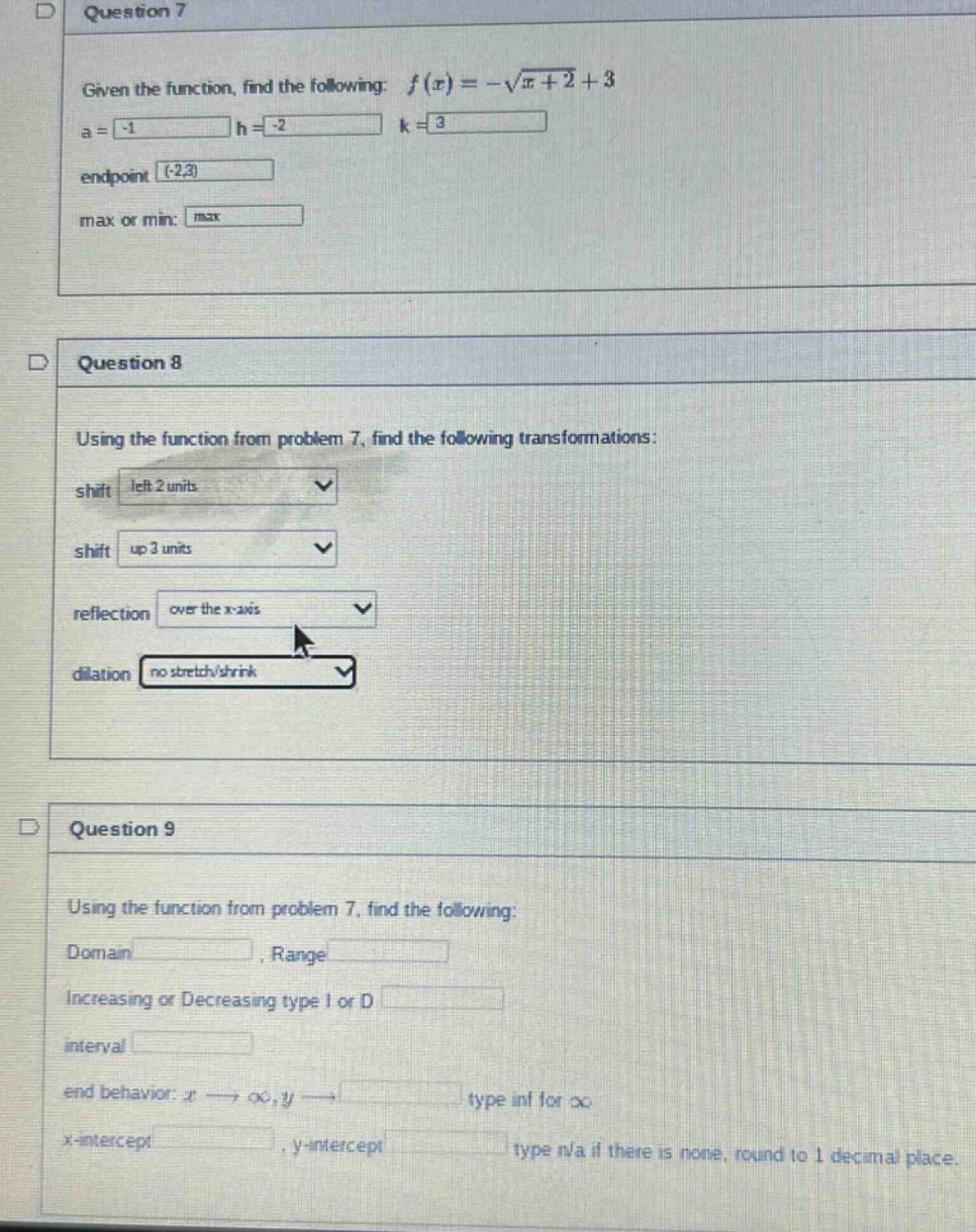
question 7 given the function, find the following: f(x)=-√(x + 2)+3 a = -1 h = -2 k = 3 endpoint (-2,3) max or min: max question 8 using the function from problem 7, find the following transformations: shift left 2 units shift up 3 units reflection over the x - axis dilation no stretch/shrink question 9 using the function from problem 7, find the following: domain, range increasing or decreasing type i or d interval end behavior: x→∞,y→ type inf for ∞ x - intercept, y - intercept type n/a if there is none. round to 1 decimal place.
Answer
Explanation:
Question 7
Step1: Identify the form of the function
The function $f(x)=-\sqrt{x + 2}+3$ is in the form $y = a\sqrt{x - h}+k$. Here, $a=- 1$, $h=-2$, $k = 3$. The endpoint of the square - root function $y=\sqrt{x}$ is shifted. For $y=\sqrt{x}$, the endpoint is $(0,0)$. For $y=\sqrt{x + 2}$, it is shifted 2 units to the left to $(-2,0)$, and for $y=-\sqrt{x + 2}+3$, it is shifted 3 units up to $(-2,3)$. Since $a=-1<0$, the function has a maximum value.
Question 8
Step1: Analyze the transformations
For the function $y = f(x)=-\sqrt{x + 2}+3$ compared to the parent - function $y=\sqrt{x}$:
- The $x+2$ inside the square - root means a shift of 2 units to the left.
- The $+3$ outside the square - root means a shift of 3 units up.
- The negative sign in front of the square - root means a reflection over the $x$ - axis.
- There is no coefficient $a$ (other than $a = - 1$ which only causes reflection) multiplying the square - root part to cause a stretch or shrink, so there is no stretch/shrink.
Question 9
Step1: Find the domain
For the square - root function $y =-\sqrt{x + 2}+3$, the expression inside the square - root must be non - negative. So $x+2\geq0$, which gives $x\geq - 2$. The domain is $[-2,\infty)$.
Step2: Find the range
Since the square - root function $\sqrt{x + 2}\geq0$, then $-\sqrt{x + 2}\leq0$, and $-\sqrt{x + 2}+3\leq3$. The range is $(-\infty,3]$.
Step3: Determine increasing or decreasing
The parent function $y = \sqrt{x}$ is increasing. But since $y=-\sqrt{x + 2}+3$ has a negative coefficient in front of the square - root, it is decreasing. So the type is D.
Step4: Find the interval
The function is decreasing for all values in its domain, so the interval is $[-2,\infty)$.
Step5: Analyze the end - behavior
As $x\rightarrow\infty$, $\sqrt{x + 2}\rightarrow\infty$, then $-\sqrt{x + 2}\rightarrow-\infty$, and $y=-\sqrt{x + 2}+3\rightarrow-\infty$.
Step6: Find the x - intercept
Set $y = 0$. Then $0=-\sqrt{x + 2}+3$, so $\sqrt{x + 2}=3$. Squaring both sides gives $x + 2 = 9$, and $x=7$.
Step7: Find the y - intercept
Set $x = 0$. Then $y=-\sqrt{0 + 2}+3=3-\sqrt{2}\approx3 - 1.4=1.6$.
Answer:
Question 7
$a=-1$, $h = - 2$, $k = 3$, endpoint $(-2,3)$, max or min: max
Question 8
shift: left 2 units, shift: up 3 units, reflection: over the x - axis, dilation: no stretch/shrink
Question 9
Domain: $[-2,\infty)$, Range: $(-\infty,3]$, Increasing or Decreasing type: D, Interval: $[-2,\infty)$, end behavior: $x\rightarrow\infty,y\rightarrow-\infty$, x - intercept: 7, y - intercept: 1.6