question the graph of y = f(x) is graphed below. what is the end - behavior of f(x)? answer as x→∞,f(x)→−∞…
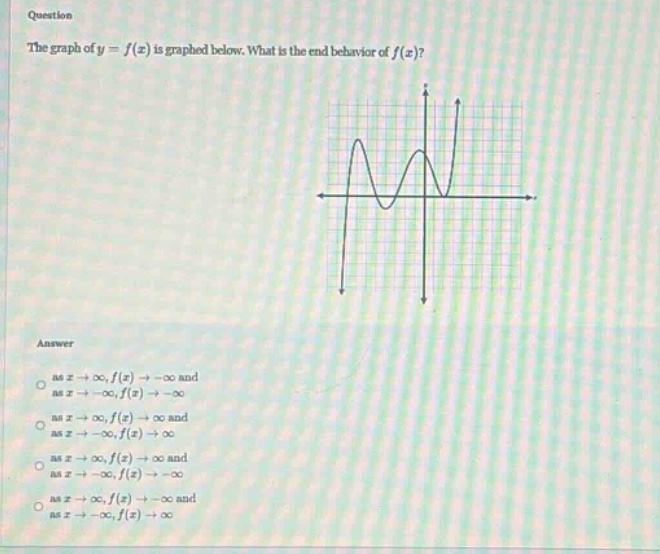
question the graph of y = f(x) is graphed below. what is the end - behavior of f(x)? answer as x→∞,f(x)→−∞ and as x→−∞,f(x)→−∞ as x→∞,f(x)→∞ and as x→−∞,f(x)→∞ as x→∞,f(x)→∞ and as x→−∞,f(x)→−∞ as x→∞,f(x)→−∞ and as x→−∞,f(x)→∞
Answer
Explanation:
Step1: Analyze right - hand end behavior
As (x\to+\infty), looking at the right - hand side of the graph, the (y) - values (i.e., (f(x))) are increasing without bound. So (f(x)\to+\infty) as (x\to+\infty).
Step2: Analyze left - hand end behavior
As (x\to-\infty), looking at the left - hand side of the graph, the (y) - values (i.e., (f(x))) are decreasing without bound. So (f(x)\to-\infty) as (x\to-\infty).
Answer:
As (x\to+\infty,f(x)\to+\infty) and as (x\to-\infty,f(x)\to-\infty)