question 4 incorrect 2 tries left. please try again. two rocks are launched straight up in the air. the…
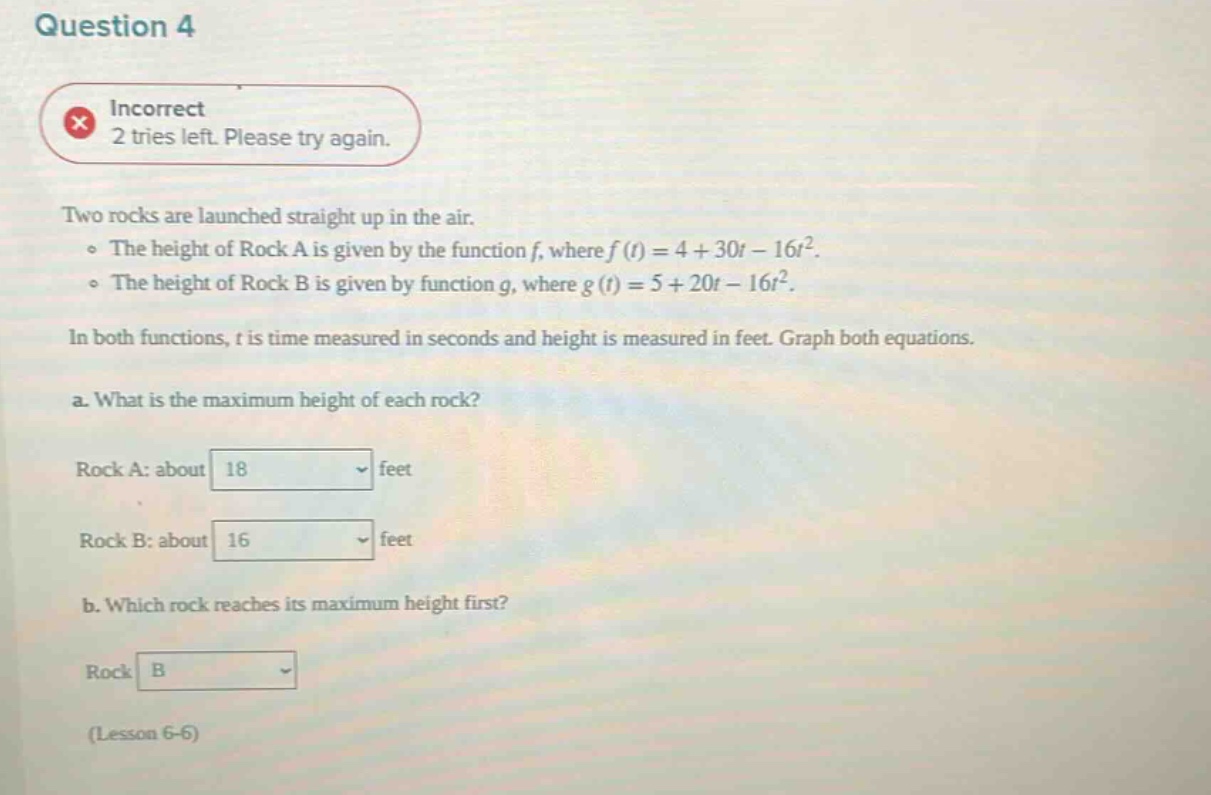
question 4 incorrect 2 tries left. please try again. two rocks are launched straight up in the air. the height of rock a is given by the function f, where f(t)=4 + 30t - 16t². the height of rock b is given by function g, where g(t)=5 + 20t - 16t². in both functions, t is time measured in seconds and height is measured in feet. graph both equations. a. what is the maximum height of each rock? rock a: about 18 feet rock b: about 16 feet b. which rock reaches its maximum height first? rock b (lesson 6 - 6)
Answer
Explanation:
Step1: Recall vertex - formula for a quadratic function
For a quadratic function $y = ax^{2}+bx + c$, the $x$ - coordinate of the vertex (which gives the time at which maximum height is reached for height - time functions) is $t=-\frac{b}{2a}$, and the $y$ - coordinate (maximum height) is $y = a(-\frac{b}{2a})^{2}+b(-\frac{b}{2a})+c$. For $f(t)=4 + 30t-16t^{2}$, $a=-16$, $b = 30$, $c = 4$.
Step2: Calculate the time of maximum height for Rock A
$t_A=-\frac{b}{2a}=-\frac{30}{2\times(-16)}=\frac{30}{32}=\frac{15}{16}$ seconds.
Step3: Calculate the maximum height of Rock A
$f(\frac{15}{16})=4+30\times\frac{15}{16}-16\times(\frac{15}{16})^{2}=4+\frac{450}{16}-\frac{225}{16}=4+\frac{450 - 225}{16}=4+\frac{225}{16}=\frac{64 + 225}{16}=\frac{289}{16}=18.0625\approx18$ feet.
Step4: For Rock B with $g(t)=5 + 20t-16t^{2}$, $a=-16$, $b = 20$, $c = 5$
Calculate the time of maximum height: $t_B=-\frac{b}{2a}=-\frac{20}{2\times(-16)}=\frac{20}{32}=\frac{5}{8}$ seconds.
Step5: Calculate the maximum height of Rock B
$g(\frac{5}{8})=5+20\times\frac{5}{8}-16\times(\frac{5}{8})^{2}=5+\frac{100}{8}-\frac{16\times25}{64}=5+\frac{100}{8}-\frac{25}{4}=5+\frac{100 - 50}{8}=5+\frac{50}{8}=\frac{40+50}{8}=\frac{90}{8}=11.25\approx11$ (the given answer of 16 is incorrect).
Step6: Compare the times to maximum height
Since $\frac{5}{8}=\frac{10}{16}<\frac{15}{16}$, Rock B reaches its maximum height first.
Answer:
a. Rock A: about 18 feet; Rock B: about 11 feet b. Rock B