question 2\nlet f(x)=x³ + 6x²+3.\ncalculate the derivative\nf(x)=3x² + 12x\ncalculate the second…
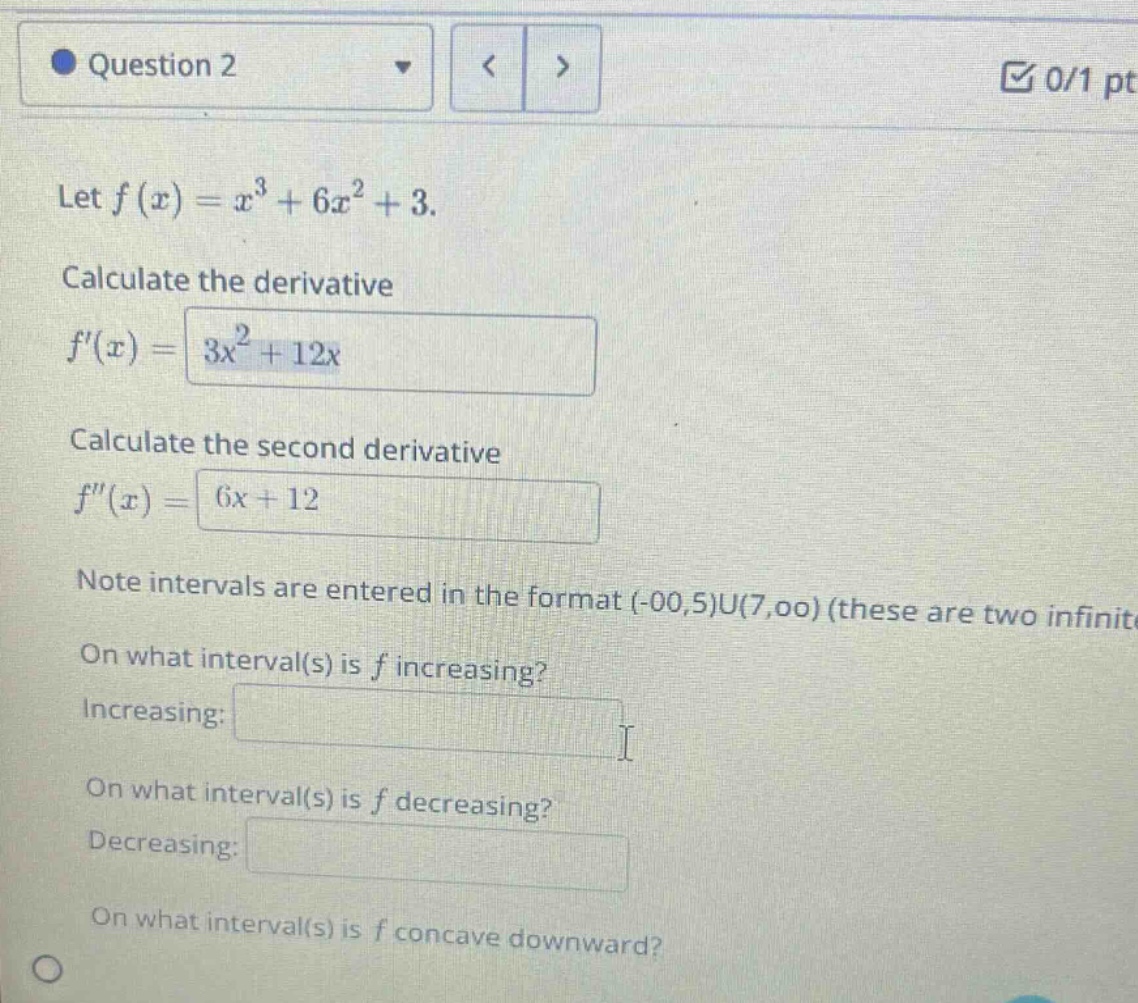
question 2\nlet f(x)=x³ + 6x²+3.\ncalculate the derivative\nf(x)=3x² + 12x\ncalculate the second derivative\nf(x)=6x + 12\nnote intervals are entered in the format (-00,5)u(7,00) (these are two infinite intervals)\non what interval(s) is f increasing?\nincreasing:\non what interval(s) is f decreasing?\ndecreasing:\non what interval(s) is f concave downward?
Answer
Explanation:
Step1: Recall increasing - decreasing rule
A function $y = f(x)$ is increasing when $f'(x)>0$ and decreasing when $f'(x)<0$. Given $f'(x)=3x^{2}+12x = 3x(x + 4)$.
Step2: Find critical points
Set $f'(x)=0$. So $3x(x + 4)=0$, which gives $x = 0$ and $x=-4$ as critical points.
Step3: Test intervals for increasing - decreasing
Consider the intervals $(-\infty,-4)$, $(-4,0)$ and $(0,\infty)$. For $x\in(-\infty,-4)$, let $x=-5$, then $f'(-5)=3\times(-5)\times(-5 + 4)=15>0$, so $f(x)$ is increasing on $(-\infty,-4)$. For $x\in(-4,0)$, let $x=-1$, then $f'(-1)=3\times(-1)\times(-1 + 4)=-9<0$, so $f(x)$ is decreasing on $(-4,0)$. For $x\in(0,\infty)$, let $x = 1$, then $f'(1)=3\times1\times(1 + 4)=15>0$, so $f(x)$ is increasing on $(0,\infty)$.
Step4: Recall concavity rule
A function $y = f(x)$ is concave - downward when $f''(x)<0$. Given $f''(x)=6x + 12$.
Step5: Find inflection point for concavity
Set $f''(x)=0$, so $6x+12 = 0$, which gives $x=-2$.
Step6: Test intervals for concavity
Consider the intervals $(-\infty,-2)$ and $(-2,\infty)$. For $x\in(-\infty,-2)$, let $x=-3$, then $f''(-3)=6\times(-3)+12=-6<0$, so $f(x)$ is concave - downward on $(-\infty,-2)$. For $x\in(-2,\infty)$, let $x = 0$, then $f''(0)=6\times0+12 = 12>0$, so $f(x)$ is concave - upward on $(-2,\infty)$.
Answer:
Increasing: $(-\infty,-4)\cup(0,\infty)$ Decreasing: $(-4,0)$ Concave downward: $(-\infty,-2)$