question let the region r be the area enclosed by the function f(x)=2x^(1/3) and g(x)=(2/3)x. if the region…
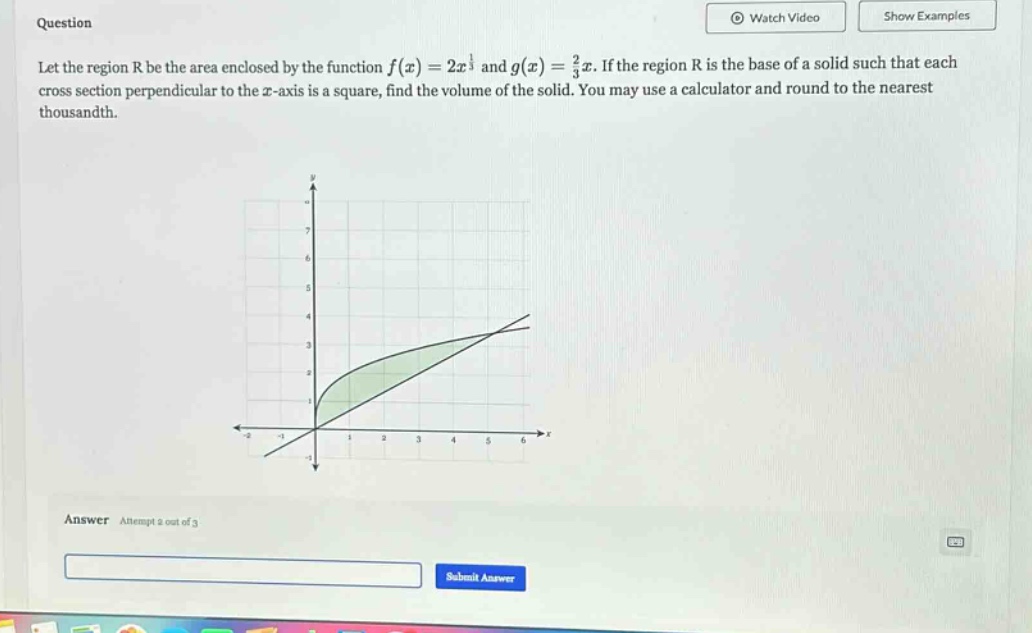
question let the region r be the area enclosed by the function f(x)=2x^(1/3) and g(x)=(2/3)x. if the region r is the base of a solid such that each cross - section perpendicular to the x - axis is a square, find the volume of the solid. you may use a calculator and round to the nearest thousandth. answer attempt 2 out of 3
Answer
Explanation:
Step1: Find intersection points
Set $2x^{\frac{1}{3}}=\frac{2}{3}x$. Let $t = x^{\frac{1}{3}}$, then $2t=\frac{2}{3}t^{3}$, which simplifies to $t^{3}-3t = 0$, factoring gives $t(t^{2}-3)=0$. So $t = 0,\pm\sqrt{3}$, and $x=0, \pm 3\sqrt{3}$. Since the region in the graph is in the first - quadrant, we consider the intersection points $x = 0$ and $x=3$.
Step2: Determine side - length of square cross - section
The side - length $s$ of each square cross - section perpendicular to the $x$ - axis is $s=\left(2x^{\frac{1}{3}}-\frac{2}{3}x\right)$.
Step3: Set up the volume integral
The volume $V$ of the solid with square cross - sections is given by the integral $V=\int_{a}^{b}s^{2}dx$, where $a = 0$, $b = 3$, and $s = 2x^{\frac{1}{3}}-\frac{2}{3}x$. So $V=\int_{0}^{3}\left(2x^{\frac{1}{3}}-\frac{2}{3}x\right)^{2}dx$. Expand the integrand: $\left(2x^{\frac{1}{3}}-\frac{2}{3}x\right)^{2}=4x^{\frac{2}{3}}-\frac{8}{3}x^{\frac{4}{3}}+\frac{4}{9}x^{2}$.
Step4: Integrate term - by - term
$\int_{0}^{3}\left(4x^{\frac{2}{3}}-\frac{8}{3}x^{\frac{4}{3}}+\frac{4}{9}x^{2}\right)dx=4\int_{0}^{3}x^{\frac{2}{3}}dx-\frac{8}{3}\int_{0}^{3}x^{\frac{4}{3}}dx+\frac{4}{9}\int_{0}^{3}x^{2}dx$. Using the power rule $\int x^{n}dx=\frac{x^{n + 1}}{n+1}+C(n\neq - 1)$, we have: $4\times\frac{3}{5}x^{\frac{5}{3}}\big|{0}^{3}-\frac{8}{3}\times\frac{3}{7}x^{\frac{7}{3}}\big|{0}^{3}+\frac{4}{9}\times\frac{1}{3}x^{3}\big|_{0}^{3}$. $=\frac{12}{5}\times3^{\frac{5}{3}}-\frac{8}{7}\times3^{\frac{7}{3}}+\frac{4}{27}\times27$. $=\frac{12}{5}\times3^{\frac{5}{3}}-\frac{8}{7}\times3^{\frac{7}{3}} + 4$. Using a calculator: $\frac{12}{5}\times3^{\frac{5}{3}}\approx\frac{12}{5}\times5.2002\approx12.4805$ $\frac{8}{7}\times3^{\frac{7}{3}}\approx\frac{8}{7}\times14.6969\approx16.7964$ $V=12.4805-16.7964 + 4= - 0.3159+4=3.6841\approx3.684$.
Answer:
$3.684$