question let the region r be the area enclosed by the function f(x)=3x² and g(x)=4x. find the volume of the…
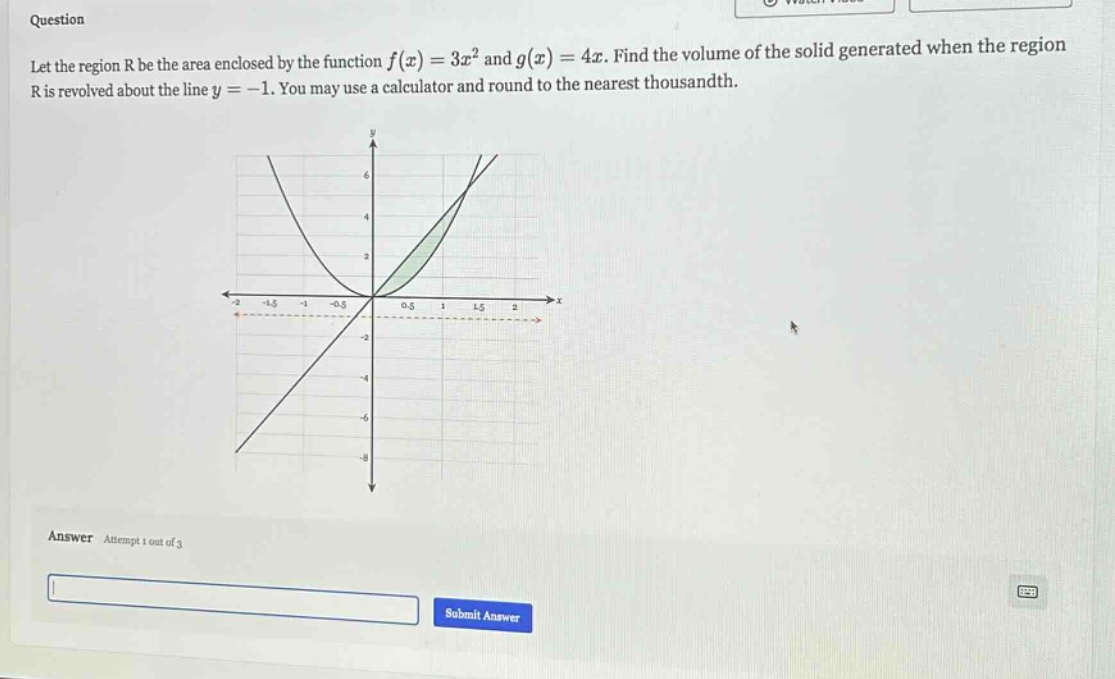
question let the region r be the area enclosed by the function f(x)=3x² and g(x)=4x. find the volume of the solid generated when the region r is revolved about the line y = -1. you may use a calculator and round to the nearest thousandth. answer attempt 1 out of 3 submit answer
Answer
Explanation:
Step1: Find intersection points
Set $3x^{2}=4x$, then $3x^{2}-4x = 0$, $x(3x - 4)=0$. So $x = 0$ and $x=\frac{4}{3}$.
Step2: Use the washer - method formula
The formula for the volume $V$ of the solid of revolution about the line $y = k$ using the washer - method is $V=\pi\int_{a}^{b}([R(x)]^{2}-[r(x)]^{2})dx$, where $R(x)$ is the outer radius and $r(x)$ is the inner radius. Here, $R(x)=(4x + 1)$ and $r(x)=(3x^{2}+1)$, $a = 0$, $b=\frac{4}{3}$. So $V=\pi\int_{0}^{\frac{4}{3}}((4x + 1)^{2}-(3x^{2}+1)^{2})dx$.
Step3: Expand the integrand
$(4x + 1)^{2}=16x^{2}+8x + 1$ and $(3x^{2}+1)^{2}=9x^{4}+6x^{2}+1$. Then $(4x + 1)^{2}-(3x^{2}+1)^{2}=16x^{2}+8x + 1-(9x^{4}+6x^{2}+1)=-9x^{4}+10x^{2}+8x$.
Step4: Integrate term - by - term
$\int(-9x^{4}+10x^{2}+8x)dx=-9\times\frac{x^{5}}{5}+10\times\frac{x^{3}}{3}+8\times\frac{x^{2}}{2}+C=-\frac{9}{5}x^{5}+\frac{10}{3}x^{3}+4x^{2}+C$.
Step5: Evaluate the definite integral
$V=\pi\left[-\frac{9}{5}x^{5}+\frac{10}{3}x^{3}+4x^{2}\right]_{0}^{\frac{4}{3}}$. $V=\pi\left(-\frac{9}{5}\times\left(\frac{4}{3}\right)^{5}+\frac{10}{3}\times\left(\frac{4}{3}\right)^{3}+4\times\left(\frac{4}{3}\right)^{2}\right)$. $V=\pi\left(-\frac{9}{5}\times\frac{1024}{243}+\frac{10}{3}\times\frac{64}{27}+4\times\frac{16}{9}\right)$. $V=\pi\left(-\frac{1024}{135}+\frac{640}{81}+\frac{64}{9}\right)$. Find a common denominator of 405: $V=\pi\left(-\frac{1024\times 3}{405}+\frac{640\times 5}{405}+\frac{64\times 45}{405}\right)$. $V=\pi\left(\frac{- 3072+3200 + 2880}{405}\right)=\pi\left(\frac{-3072 + 6080}{405}\right)=\pi\times\frac{3008}{405}\approx23.370$.
Answer:
$23.370$