question let the region r be the area enclosed by the function f(x)=3x^(1/3), the horizontal line y = -1 and…
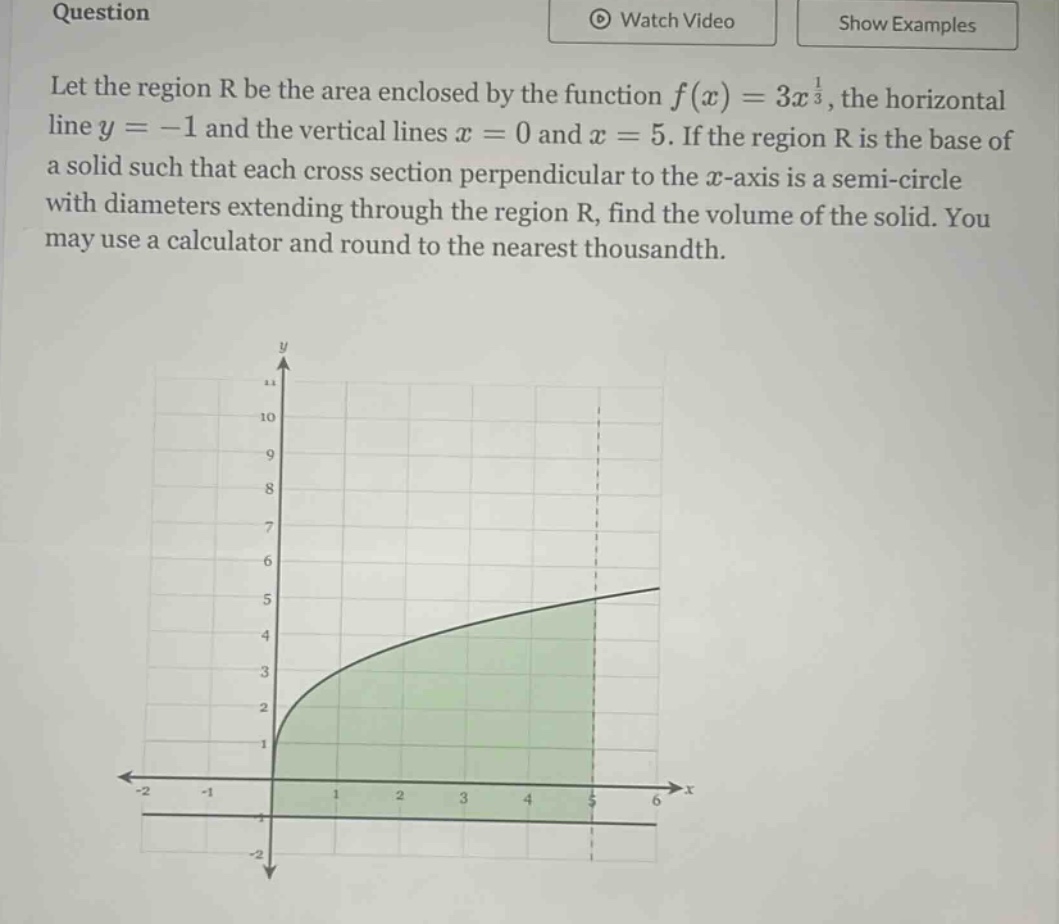
question let the region r be the area enclosed by the function f(x)=3x^(1/3), the horizontal line y = -1 and the vertical lines x = 0 and x = 5. if the region r is the base of a solid such that each cross - section perpendicular to the x - axis is a semi - circle with diameters extending through the region r, find the volume of the solid. you may use a calculator and round to the nearest thousandth.
Answer
Explanation:
Step1: Find the diameter of the semi - circle
The diameter (d) of each semi - circle cross - section perpendicular to the (x) - axis is given by the difference between the upper and lower functions. The upper function is (y = 3x^{\frac{1}{3}}) and the lower function is (y=-1). So, (d = 3x^{\frac{1}{3}}-(-1)=3x^{\frac{1}{3}} + 1).
Step2: Find the radius of the semi - circle
The radius (r) of the semi - circle is half of the diameter. So, (r=\frac{3x^{\frac{1}{3}} + 1}{2}).
Step3: Find the area of the semi - circle
The area of a semi - circle is (A=\frac{1}{2}\pi r^{2}). Substituting (r=\frac{3x^{\frac{1}{3}} + 1}{2}) into the formula, we get (A(x)=\frac{\pi}{2}(\frac{3x^{\frac{1}{3}} + 1}{2})^{2}=\frac{\pi}{8}(9x^{\frac{2}{3}}+6x^{\frac{1}{3}} + 1)).
Step4: Use the integral to find the volume
The volume (V) of the solid with cross - sectional area (A(x)) from (x = 0) to (x = 5) is given by the definite integral (V=\int_{a}^{b}A(x)dx), where (a = 0), (b = 5). So, (V=\int_{0}^{5}\frac{\pi}{8}(9x^{\frac{2}{3}}+6x^{\frac{1}{3}} + 1)dx). We know that (\int x^{n}dx=\frac{x^{n + 1}}{n+1}+C) ((n\neq - 1)). [ \begin{align*} V&=\frac{\pi}{8}\left[\int_{0}^{5}(9x^{\frac{2}{3}}+6x^{\frac{1}{3}} + 1)dx\right]\ &=\frac{\pi}{8}\left[9\times\frac{x^{\frac{2}{3}+1}}{\frac{2}{3}+1}+6\times\frac{x^{\frac{1}{3}+1}}{\frac{1}{3}+1}+x\right]{0}^{5}\ &=\frac{\pi}{8}\left[9\times\frac{x^{\frac{5}{3}}}{\frac{5}{3}}+6\times\frac{x^{\frac{4}{3}}}{\frac{4}{3}}+x\right]{0}^{5}\ &=\frac{\pi}{8}\left[\frac{27}{5}x^{\frac{5}{3}}+\frac{9}{2}x^{\frac{4}{3}}+x\right]_{0}^{5} \end{align*} ] Substitute the upper and lower limits: [ \begin{align*} V&=\frac{\pi}{8}\left(\frac{27}{5}\times5^{\frac{5}{3}}+\frac{9}{2}\times5^{\frac{4}{3}}+5\right)\ &\approx\frac{\pi}{8}( \frac{27}{5}\times11.180+ \frac{9}{2}\times6.694 + 5)\ &\approx\frac{\pi}{8}(59.976+30.123 + 5)\ &\approx\frac{\pi}{8}(95.099)\ &\approx37.307 \end{align*} ]
Answer:
(37.307)