question 3 3. match the following: horizontal asymptote when does it happen? y = #/# when the degree of the…
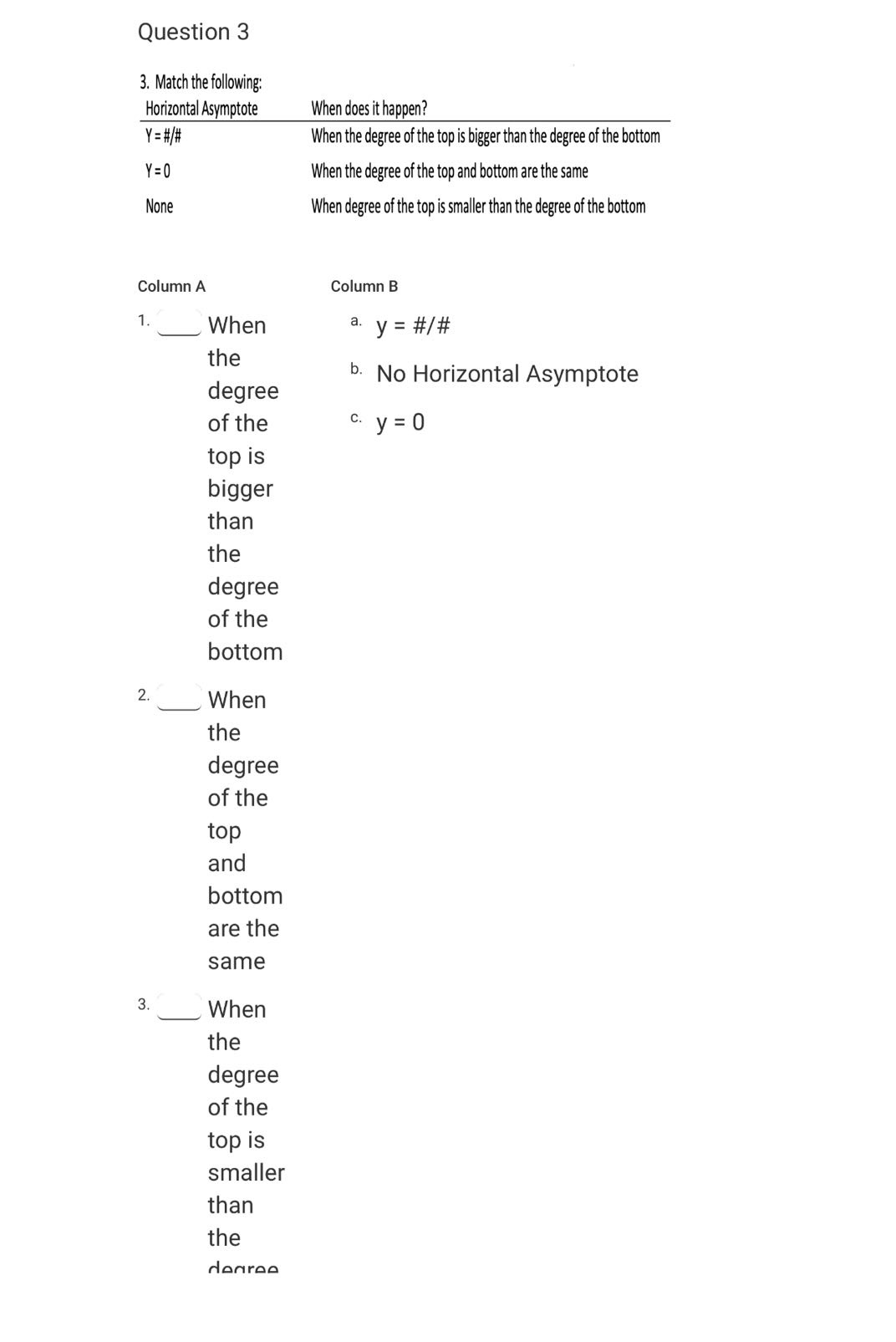
question 3 3. match the following: horizontal asymptote when does it happen? y = #/# when the degree of the top is bigger than the degree of the bottom y = 0 when the degree of the top and bottom are the same none when degree of the top is smaller than the degree of the bottom column a column b 1. when the degree of the top is bigger than the degree of the bottom a. y = #/# b. no horizontal asymptote c. y = 0 2. when the degree of the top and bottom are the same 3. when the degree of the top is smaller than the degree
Answer
Answer:
- a. y = #/#
- c. y = 0
- b. No Horizontal Asymptote
Explanation:
Step1: Recall asymptote rules
For rational - functions $\frac{f(x)}{g(x)}$, when $\text{deg}(f(x))>\text{deg}(g(x))$, there is no horizontal asymptote and the function behaves like a non - constant polynomial as $x\to\pm\infty$.
Step2: Match case 1
When the degree of the top is bigger than the degree of the bottom, there is no horizontal asymptote and the function has a slant or non - horizontal oblique asymptote (represented as $y = \text{non - constant rational function}$, here $y=#/#$).
Step3: Match case 2
When the degree of the top and bottom are the same, the horizontal asymptote is $y=\frac{a_n}{b_n}$, where $a_n$ and $b_n$ are the leading coefficients of the numerator and denominator polynomials respectively. In a general sense, we say $y =$ a non - zero constant, and here it is given as $y = 0$ can be a special case when the leading - coefficient ratio is 0.
Step4: Match case 3
When the degree of the top is smaller than the degree of the bottom, as $x\to\pm\infty$, the function approaches 0, so the horizontal asymptote is $y = 0$. So when the degree of the top is smaller than the degree of the bottom, we have no horizontal asymptote in the non - zero constant sense, and we match it with "No Horizontal Asymptote".