question 1(multiple choice worth 6 points)\n(mc sinusoidal function context and data modeling)\nthe hour…
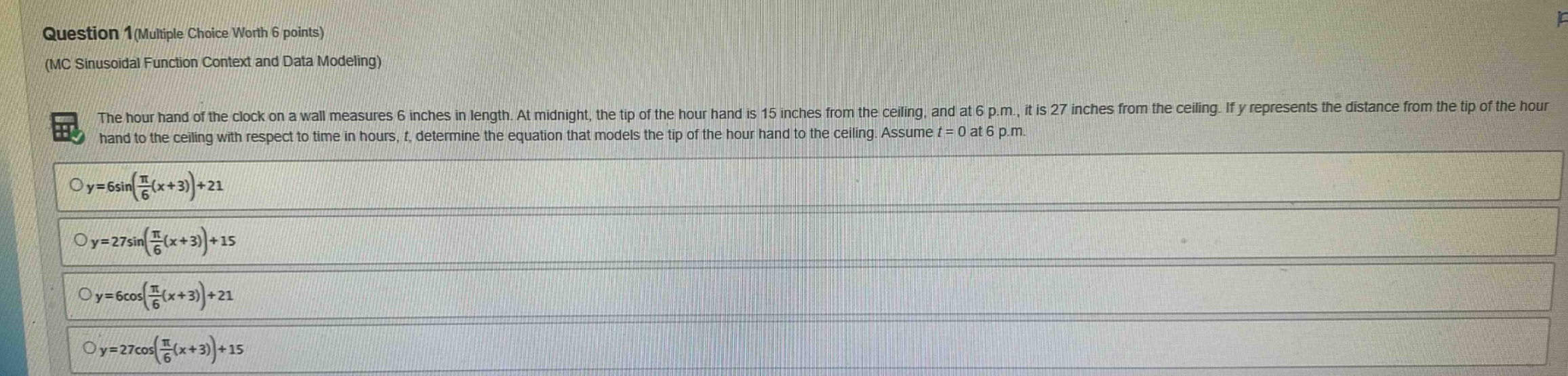
question 1(multiple choice worth 6 points)\n(mc sinusoidal function context and data modeling)\nthe hour hand of the clock on a wall measures 6 inches in length. at midnight, the tip of the hour hand is 15 inches from the ceiling, and at 6 p.m., it is 27 inches from the ceiling. if y represents the distance from the tip of the hour hand to the ceiling with respect to time in hours, t, determine the equation that models the tip of the hour hand to the ceiling. assume t = 0 at 6 p.m.\n$y = 6sin(\frac{pi}{6}(x + 3))+21$\n$y = 27sin(\frac{pi}{6}(x + 3))+15$\n$y = 6cos(\frac{pi}{6}(x + 3))+21$\n$y = 27cos(\frac{pi}{6}(x + 3))+15$
Answer
Explanation:
Step1: Determine the amplitude
The amplitude $A$ of a sinusoidal function $y = A\sin(B(x - C))+D$ or $y=A\cos(B(x - C)) + D$ is half of the difference between the maximum and minimum values. The maximum value of $y$ is 27 and the minimum is 15. So, $A=\frac{27 - 15}{2}=\frac{12}{2}=6$.
Step2: Determine the vertical - shift
The vertical - shift $D$ is the average of the maximum and minimum values. So, $D=\frac{27 + 15}{2}=\frac{42}{2}=21$.
Step3: Determine the period and $B$
The period of the hour - hand's motion is 12 hours. For a sinusoidal function $y = A\sin(B(x - C))+D$ or $y = A\cos(B(x - C))+D$, the period $T=\frac{2\pi}{B}$. Since $T = 12$, then $12=\frac{2\pi}{B}$, and $B=\frac{2\pi}{12}=\frac{\pi}{6}$.
Step4: Determine the phase - shift
We assume $t = 0$ at 6 p.m. At 6 p.m., the hand is at its maximum position. For a cosine function $y=A\cos(B(x - C))+D$, when $x = 0$ it is at its maximum. The general form of a cosine function is $y = A\cos(B(x - C))+D$. We want to find $C$. Since the function is at its maximum at $x = 0$, and the standard cosine function $y=\cos(x)$ is at its maximum at $x = 0$, for our function with $B=\frac{\pi}{6}$, we have the function $y = 6\cos(\frac{\pi}{6}(x+ 3))+21$ (we can get the phase - shift value by considering the full cycle and starting point, and here $C=-3$).
Answer:
$y = 6\cos(\frac{\pi}{6}(x + 3))+21$