question 9(multiple choice worth 1 points) (rates of change in polar functions lc) the table gives selected…
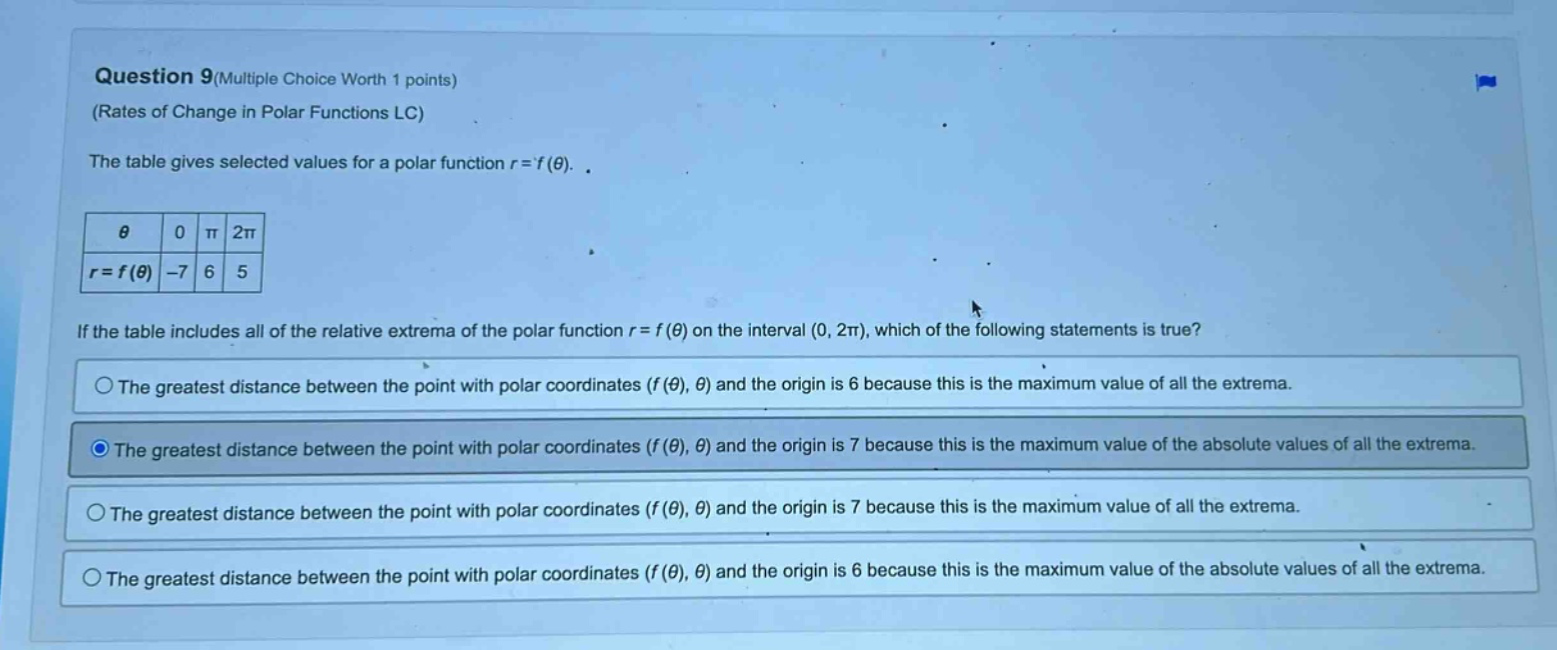
question 9(multiple choice worth 1 points) (rates of change in polar functions lc) the table gives selected values for a polar function r = f(θ). θ 0 π 2π r = f(θ) -7 6 5 if the table includes all of the relative extrema of the polar function r = f(θ) on the interval (0, 2π), which of the following statements is true? the greatest distance between the point with polar coordinates (f(θ), θ) and the origin is 6 because this is the maximum value of all the extrema. the greatest distance between the point with polar coordinates (f(θ), θ) and the origin is 7 because this is the maximum value of the absolute values of all the extrema. the greatest distance between the point with polar coordinates (f(θ), θ) and the origin is 7 because this is the maximum value of all the extrema. the greatest distance between the point with polar coordinates (f(θ), θ) and the origin is 6 because this is the maximum value of the absolute values of all the extrema.
Answer
Explanation:
Step1: Recall polar - coordinate distance
In polar coordinates, the distance between the point $(r,\theta)$ and the origin is given by $|r|$.
Step2: Find absolute - values of $r$ values
Given $r$ values are $r_1=-7$, $r_2 = 6$, $r_3=5$. The absolute values are $| - 7|=7$, $|6| = 6$, $|5|=5$.
Step3: Determine the maximum absolute value
The maximum of ${7,6,5}$ is 7.
Answer:
The greatest distance between the point with polar coordinates $(f(\theta),\theta)$ and the origin is 7 because this is the maximum value of the absolute values of all the extrema.