question 6(multiple choice worth 1 points) (rates of change in polar functions mc) consider the graph of the…
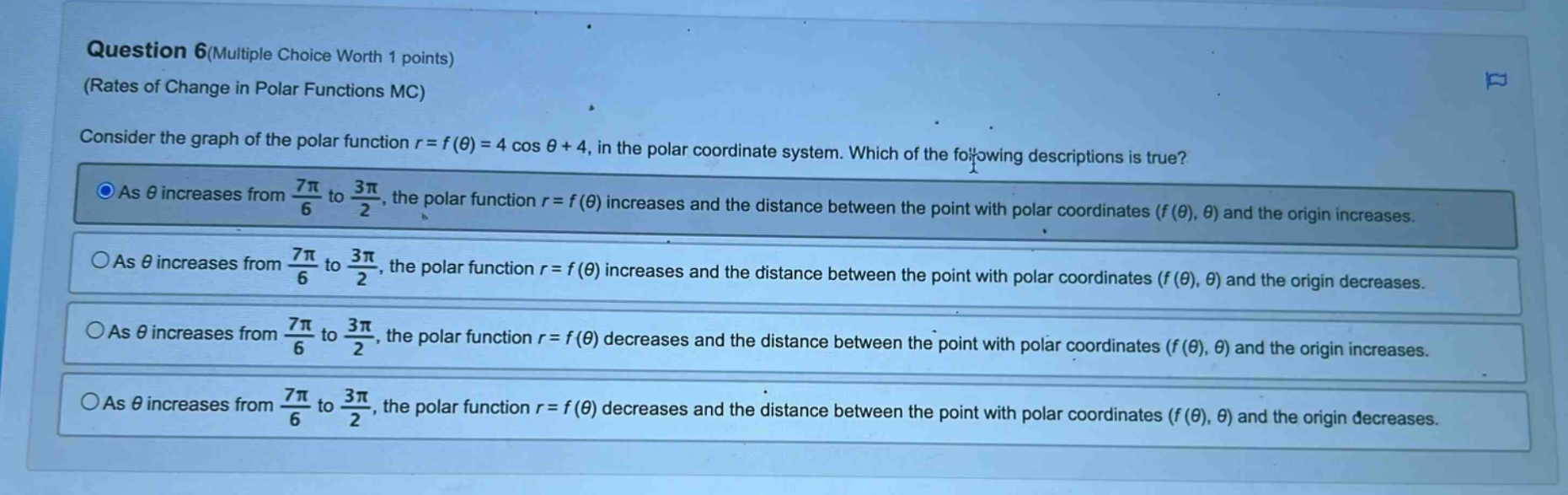
question 6(multiple choice worth 1 points) (rates of change in polar functions mc) consider the graph of the polar function r = f(θ) = 4 cos θ + 4, in the polar coordinate system. which of the following descriptions is true? as θ increases from 7π/6 to 3π/2, the polar function r = f(θ) increases and the distance between the point with polar coordinates (f(θ), θ) and the origin increases. as θ increases from 7π/6 to 3π/2, the polar function r = f(θ) increases and the distance between the point with polar coordinates (f(θ), θ) and the origin decreases. as θ increases from 7π/6 to 3π/2, the polar function r = f(θ) decreases and the distance between the point with polar coordinates (f(θ), θ) and the origin increases. as θ increases from 7π/6 to 3π/2, the polar function r = f(θ) decreases and the distance between the point with polar coordinates (f(θ), θ) and the origin decreases.
Answer
Explanation:
Step1: Analyze the polar - function
The polar function is (r = f(\theta)=4\cos\theta + 4).
Step2: Find the derivative of (r) with respect to (\theta)
We know that (\frac{dr}{d\theta}=-4\sin\theta).
Step3: Evaluate the derivative in the interval (\left[\frac{7\pi}{6},\frac{3\pi}{2}\right])
When (\theta\in\left[\frac{7\pi}{6},\frac{3\pi}{2}\right]), (\sin\theta\lt0), so (\frac{dr}{d\theta}=- 4\sin\theta>0). This means the function (r = f(\theta)) is increasing in the interval (\left[\frac{7\pi}{6},\frac{3\pi}{2}\right]).
Step4: Recall the meaning of (r) in polar - coordinates
In polar coordinates, the distance between the point ((r,\theta)) and the origin is given by (r). Since (r = f(\theta)) is increasing in the interval (\left[\frac{7\pi}{6},\frac{3\pi}{2}\right]), the distance between the point ((f(\theta),\theta)) and the origin is increasing.
Answer:
As (\theta) increases from (\frac{7\pi}{6}) to (\frac{3\pi}{2}), the polar function (r = f(\theta)) increases and the distance between the point with polar coordinates ((f(\theta),\theta)) and the origin increases.