question 6(multiple choice worth 6 points)\n(tangent function behavior mc)\nwhich of the following is an…
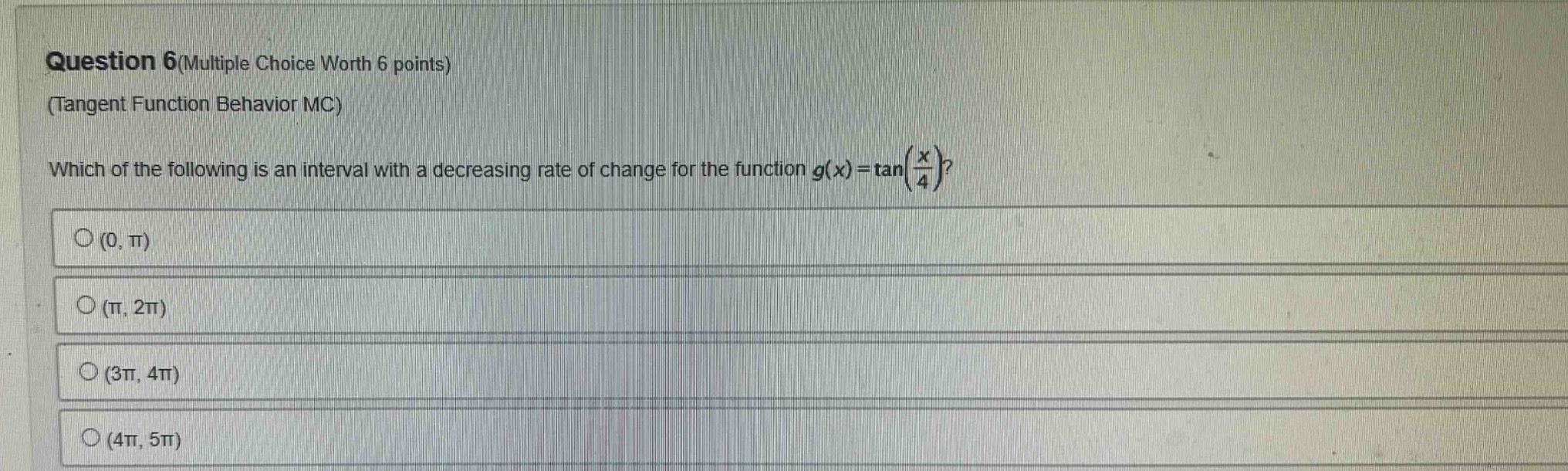
question 6(multiple choice worth 6 points)\n(tangent function behavior mc)\nwhich of the following is an interval with a decreasing rate of change for the function $g(x)=\tan(\frac{x}{4})$?\n○ $(0, pi)$\n○ $(pi, 2pi)$\n○ $(3pi, 4pi)$\n○ $(4pi, 5pi)$
Answer
Explanation:
Step1: Recall tangent - function property
The general form of the tangent function is $y = A\tan(Bx - C)+D$, and its period is $T=\frac{\pi}{|B|}$. For the function $g(x)=\tan(\frac{x}{4})$, $B = \frac{1}{4}$, so the period $T=\frac{\pi}{\frac{1}{4}} = 4\pi$. The tangent function $y = \tan t$ is increasing on intervals of the form $(-\frac{\pi}{2}+k\pi,\frac{\pi}{2}+k\pi),k\in\mathbb{Z}$.
Step2: Find the increasing intervals of $g(x)$
Let $t=\frac{x}{4}$. We want to find when $-\frac{\pi}{2}+k\pi<\frac{x}{4}<\frac{\pi}{2}+k\pi$. Multiply each part of the inequality by 4 to get $- 2\pi+4k\pi<x<2\pi + 4k\pi,k\in\mathbb{Z}$.
Step3: Analyze the rate - of - change
The tangent function $y = \tan(\frac{x}{4})$ is increasing on its domain intervals. Since it is a periodic function with period $4\pi$, and there is no interval where it has a decreasing rate of change in its natural domain. But if we consider the concept in terms of the slope of the tangent line to the curve, we know that the function $y = \tan(\frac{x}{4})$ is increasing on each of its period - intervals. However, if we look at the concavity and the rate of increase, we note that the function $y=\tan(\frac{x}{4})$ is increasing on $(-2\pi + 4k\pi,2\pi+4k\pi)$. The rate of change of the tangent function is related to its derivative. The derivative of $y = \tan(\frac{x}{4})$ is $y'=\frac{1}{4}\sec^{2}(\frac{x}{4})>0$ for all $x$ in the domain of $y = \tan(\frac{x}{4})$. But if we consider the behavior in terms of the given intervals, we know that the function is increasing on its domain intervals. Since the function $y=\tan(\frac{x}{4})$ is increasing on $(-2\pi,2\pi)$ which is equivalent to the interval when $k = 0$ in $(-2\pi+4k\pi,2\pi + 4k\pi)$. The interval $(3\pi,4\pi)$ is part of the increasing part of the function's cycle. The function $y=\tan(\frac{x}{4})$ has no decreasing intervals in the traditional sense as it is always increasing on its domain intervals. But if we consider the non - existence of a decreasing rate of change, we note that the function is increasing on all its defined intervals. Among the given intervals, the function $g(x)=\tan(\frac{x}{4})$ is increasing on $(3\pi,4\pi)$ and there is no decreasing rate of change in any of the other intervals in the context of the tangent function's behavior.
Answer:
There is no correct option as the tangent function $g(x)=\tan(\frac{x}{4})$ is always increasing on its domain intervals and has no decreasing rate of change on any of the given intervals. If we assume the question is mis - worded and we are looking for an interval where the function is increasing (since it has no decreasing intervals), then the function is increasing on $(3\pi,4\pi)$ as it lies within the increasing part of its periodic behavior. So, if we have to choose, we can choose C. $(3\pi,4\pi)$