question\na particle moves along a line with a velocity $v(t)=2t^{2}-2$, measured in meters per second. find…
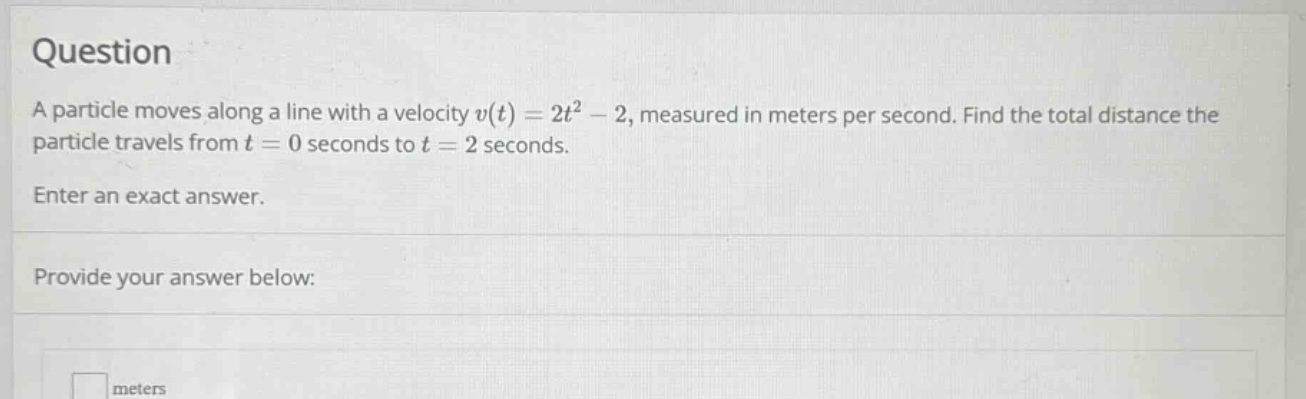
question\na particle moves along a line with a velocity $v(t)=2t^{2}-2$, measured in meters per second. find the total distance the particle travels from $t = 0$ seconds to $t = 2$ seconds.\nenter an exact answer.\nprovide your answer below:\n\nmeters
Answer
Explanation:
Step1: Find when velocity is zero
Set $v(t)=2t^{2}-2 = 0$. Then $2t^{2}=2$, $t^{2}=1$, so $t = 1$ (we consider $t\geq0$ in the context of time).
Step2: Split the integral based on sign - change of velocity
The distance $d=\int_{0}^{2}|v(t)|dt=\int_{0}^{1}-(2t^{2}-2)dt+\int_{1}^{2}(2t^{2}-2)dt$.
Step3: Integrate the first integral
$\int_{0}^{1}-(2t^{2}-2)dt=-\left[\frac{2t^{3}}{3}-2t\right]_{0}^{1}=-\left(\frac{2}{3}-2\right)=-\frac{2}{3} + 2=\frac{4}{3}$.
Step4: Integrate the second integral
$\int_{1}^{2}(2t^{2}-2)dt=\left[\frac{2t^{3}}{3}-2t\right]_{1}^{2}=\left(\frac{16}{3}-4\right)-\left(\frac{2}{3}-2\right)=\frac{16 - 12}{3}-\frac{2 - 6}{3}=\frac{4}{3}+\frac{4}{3}=\frac{8}{3}$.
Step5: Sum the two results
$d=\frac{4}{3}+\frac{8}{3}=4$.
Answer:
4