question a particle travels along the x - axis such that its velocity is given by v(t)=t^0.3 - 1 - 2sin(t)…
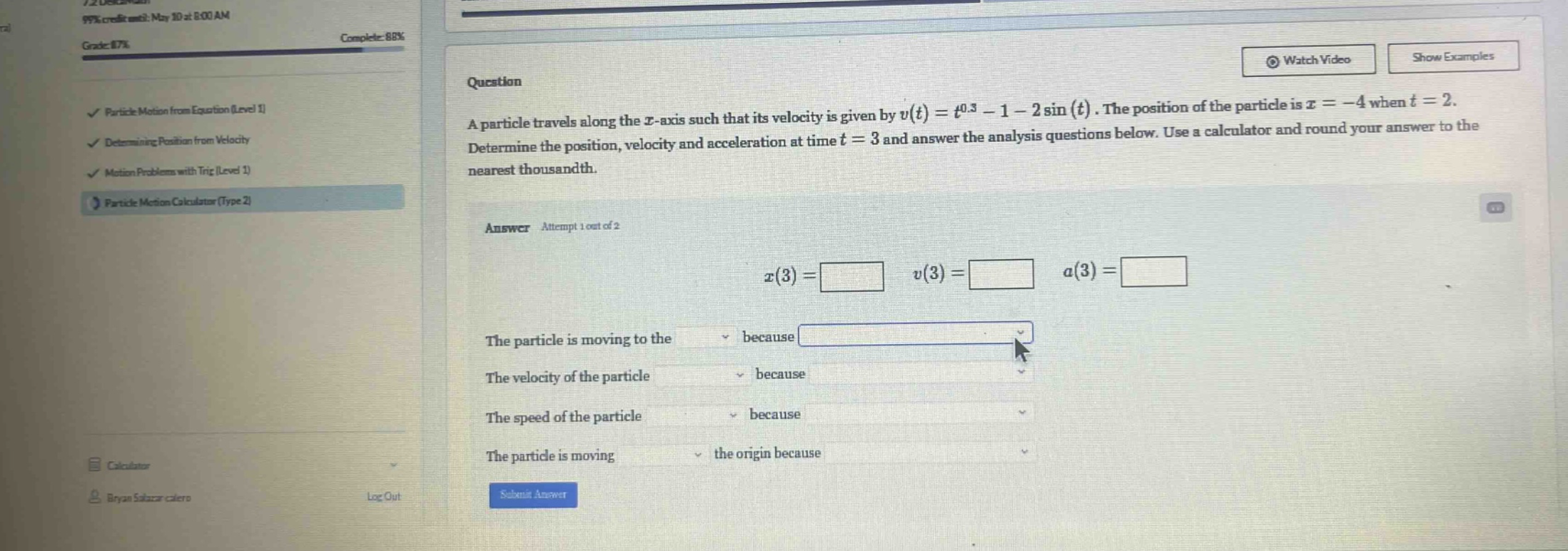
question a particle travels along the x - axis such that its velocity is given by v(t)=t^0.3 - 1 - 2sin(t). the position of the particle is x = - 4 when t = 2. determine the position, velocity and acceleration at time t = 3 and answer the analysis questions below. use a calculator and round your answer to the nearest thousandth. answer attempt 1 out of 2 x(3)= v(3)= a(3)= the particle is moving to the because the velocity of the particle because the speed of the particle because the particle is moving the origin because
Answer
Explanation:
Step1: Recall the relationship between position, velocity and acceleration
Position $x(t)$ is the antiderivative of velocity $v(t)$, and acceleration $a(t)$ is the derivative of velocity $v(t)$. Given $v(t)=t^{0.3}-1 - 2\sin(t)$. First, find the antiderivative of $v(t)$ to get $x(t)$. The general antiderivative of $v(t)$ is $x(t)=\frac{t^{1.3}}{1.3}-t + 2\cos(t)+C$.
Step2: Use the initial - condition to find the constant $C$
We know that $x(2)=-4$. Substitute $t = 2$ into $x(t)$: $x(2)=\frac{2^{1.3}}{1.3}-2 + 2\cos(2)+C=-4$. Calculate $\frac{2^{1.3}}{1.3}\approx\frac{2.462}{1.3}\approx1.894$, $\cos(2)\approx - 0.416$. Then $1.894-2+2\times(-0.416)+C=-4$. Simplify: $1.894 - 2-0.832 + C=-4$, $-0.938 + C=-4$, so $C=-4 + 0.938=-3.062$. So $x(t)=\frac{t^{1.3}}{1.3}-t + 2\cos(t)-3.062$.
Step3: Calculate $x(3)$, $v(3)$ and $a(3)$
- For $v(3)$: Substitute $t = 3$ into $v(t)$: $v(3)=3^{0.3}-1 - 2\sin(3)$. Calculate $3^{0.3}\approx1.396$, $\sin(3)\approx0.141$. Then $v(3)=1.396-1-2\times0.141=1.396 - 1 - 0.282 = 0.114$.
- For $x(3)$: Substitute $t = 3$ into $x(t)$: $x(3)=\frac{3^{1.3}}{1.3}-3 + 2\cos(3)-3.062$. Calculate $3^{1.3}\approx3.594$, $\cos(3)\approx - 0.990$. Then $x(3)=\frac{3.594}{1.3}-3+2\times(-0.990)-3.062\approx2.765-3 - 1.980-3.062=-5.277$.
- For $a(3)$: First, find the derivative of $v(t)$. $a(t)=0.3t^{-0.7}-2\cos(t)$. Substitute $t = 3$ into $a(t)$: $a(3)=0.3\times3^{-0.7}-2\cos(3)$. Calculate $3^{-0.7}=\frac{1}{3^{0.7}}\approx\frac{1}{2.157}\approx0.464$. Then $a(3)=0.3\times0.464-2\times(-0.990)=0.1392 + 1.980 = 2.119$.
Answer:
$x(3)\approx - 5.277$, $v(3)\approx0.114$, $a(3)\approx2.119$