question 1 (1 point) which of the following is true? f(x)=1/(2 - x) has two vertical asymptotes. f(x)=1/x…
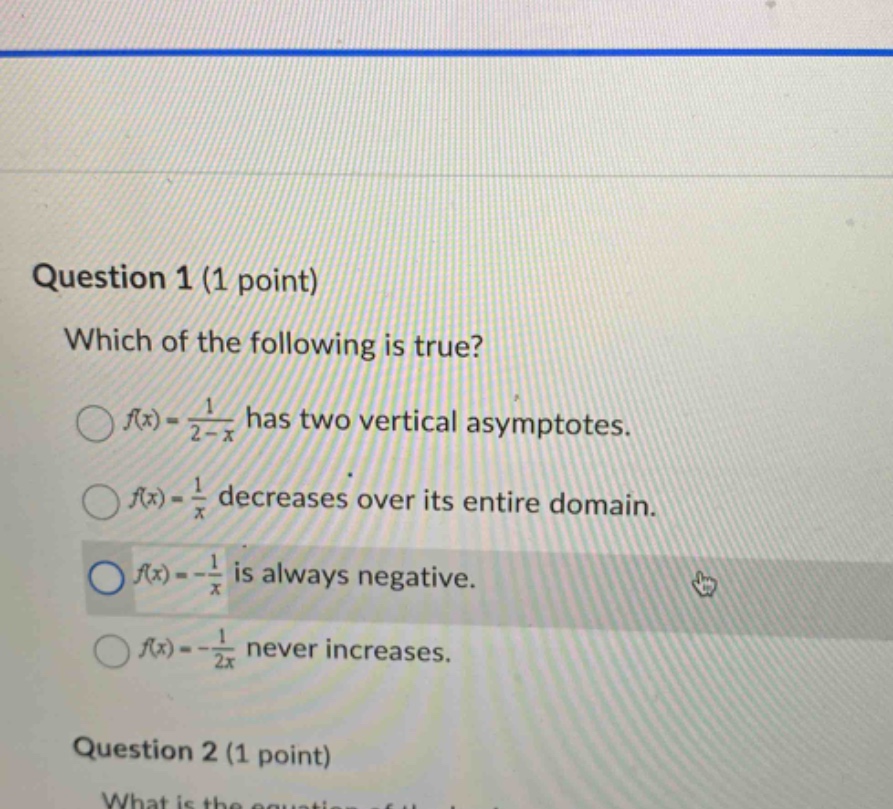
question 1 (1 point) which of the following is true? f(x)=1/(2 - x) has two vertical asymptotes. f(x)=1/x decreases over its entire domain. f(x)=-1/x is always negative. f(x)=-1/(2x) never increases. question 2 (1 point)
Answer
Answer:
- B. $f(x)=\frac{1}{x}$ decreases over its entire domain.
Explanation:
Step1: Analyze $f(x)=\frac{1}{2 - x}$
The vertical - asymptote of $y = \frac{1}{2 - x}$ is found by setting the denominator equal to zero. So, $2−x = 0$, which gives $x = 2$. It has one vertical asymptote, not two.
Step2: Analyze $f(x)=\frac{1}{x}$
The domain of $y=\frac{1}{x}$ is $x\neq0$. Its derivative is $y'=-\frac{1}{x^{2}}<0$ for all $x$ in the domain $(-\infty,0)\cup(0,\infty)$. So it is decreasing over its entire domain.
Step3: Analyze $f(x)=-\frac{1}{x}$
When $x<0$, $y =-\frac{1}{x}>0$. So it is not always negative.
Step4: Analyze $f(x)=-\frac{1}{2x}$
Its derivative is $y'=\frac{1}{2x^{2}}>0$ for $x\neq0$. So it is increasing on $(-\infty,0)$ and $(0,\infty)$.