question 2 (1 point)\ngiven the periodic function below:\ndetermine:\na) the amplitude.\nb) the axis.\nc)…
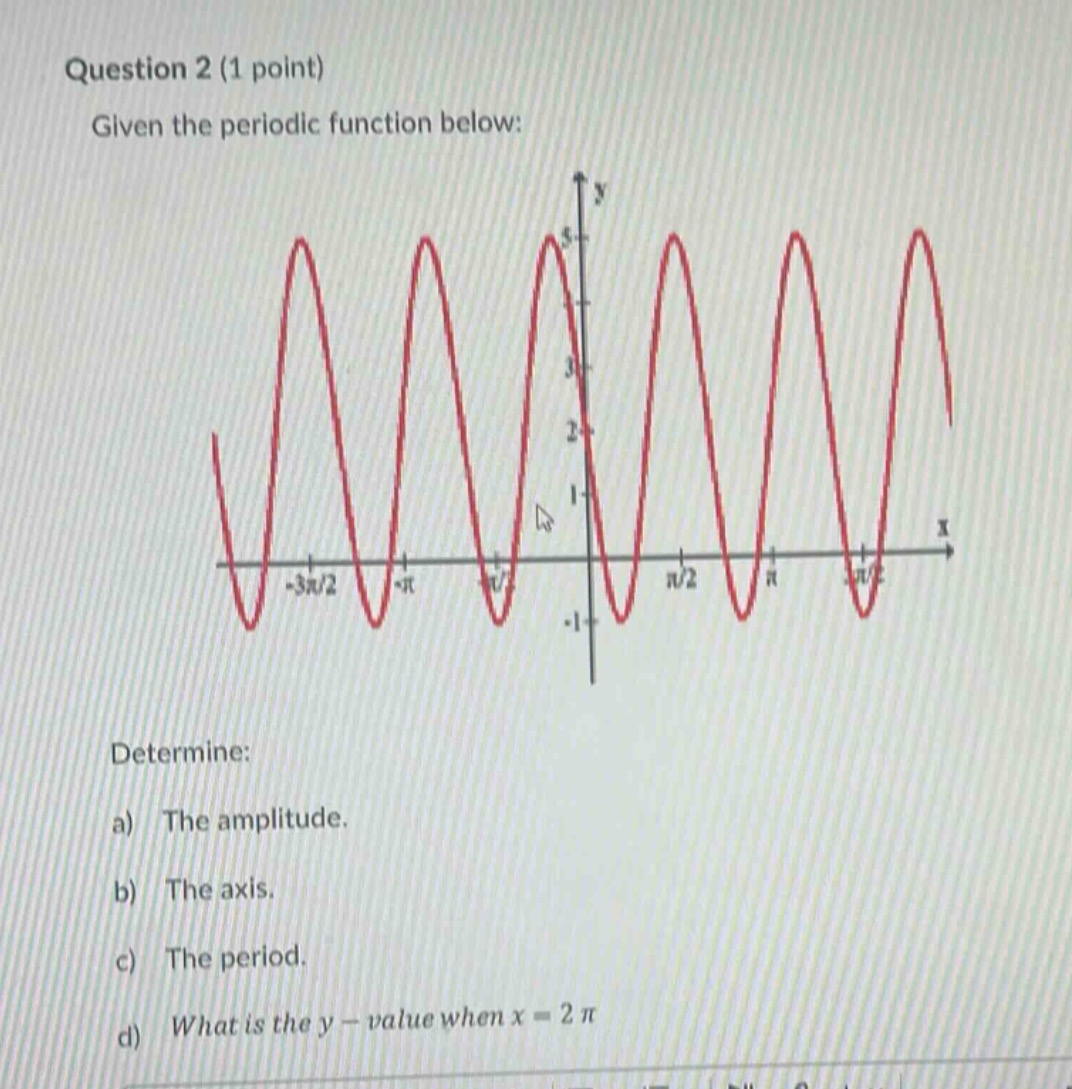
question 2 (1 point)\ngiven the periodic function below:\ndetermine:\na) the amplitude.\nb) the axis.\nc) the period.\nd) what is the y - value when x = 2π
Answer
Explanation:
Step1: Find the amplitude
The amplitude is the distance from the axis of the wave to its maximum or minimum. The maximum value is 5 and the minimum is - 1. The axis is at $y = 2$ (calculated as $\frac{5+( - 1)}{2}$). Amplitude $A=\frac{5-( - 1)}{2}=3$.
Step2: Determine the axis
The axis of a periodic - function is the mid - value between the maximum and minimum values. So, $y=\frac{5+( - 1)}{2}=2$.
Step3: Calculate the period
The period is the horizontal distance between two consecutive identical points on the wave. From the graph, we can see that the wave repeats every $\pi$ units. So the period $T = \pi$.
Step4: Find the y - value at $x = 2\pi$
Since the period is $\pi$, when $x = 2\pi$, it is equivalent to $x = 0$ (because $2\pi$ is a multiple of the period $\pi$). At $x = 0$, $y = 2$.
Answer:
a) 3 b) $y = 2$ c) $\pi$ d) 2