question a polar function is given by r = f(θ) = 2 cos (2/3θ). as θ increases on the interval -3π < θ <…
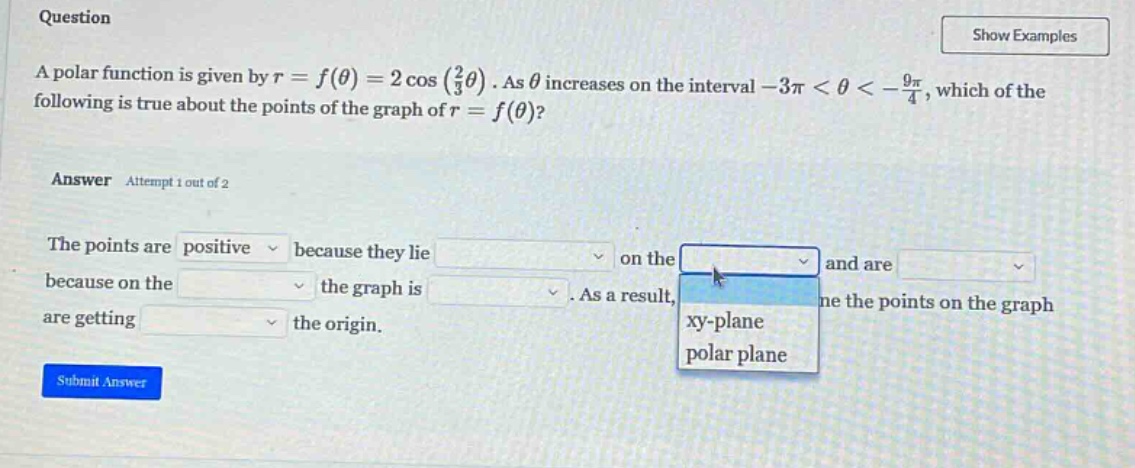
question a polar function is given by r = f(θ) = 2 cos (2/3θ). as θ increases on the interval -3π < θ < -9π/4, which of the following is true about the points of the graph of r = f(θ)? answer attempt 1 out of 2 the points are positive because they lie on the and are because on the the graph is. as a result, the points on the graph are getting the origin. submit answer
Answer
Explanation:
Step1: Analyze the polar - function
We have (r = 2\cos(\frac{2}{3}\theta)). We need to study its behavior in the interval (-3\pi<\theta<-\frac{9\pi}{4}).
Step2: Consider the range of the cosine - function
Let (u=\frac{2}{3}\theta). When (\theta=-3\pi), (u = \frac{2}{3}\times(-3\pi)= - 2\pi); when (\theta=-\frac{9\pi}{4}), (u=\frac{2}{3}\times(-\frac{9\pi}{4})=-\frac{3\pi}{2}).
Step3: Determine the sign of (r)
The cosine function (y = \cos(u)) in the interval (-2\pi<u<-\frac{3\pi}{2}) is positive. Since (r = 2\cos(\frac{2}{3}\theta)) and (\cos(\frac{2}{3}\theta)>0) in the given (\theta) - interval, (r>0).
Step4: Analyze the distance from the origin
The value of (r) represents the distance from the origin in the polar plane. As (\theta) varies in the given interval, we need to check how (r) changes. The function (r = 2\cos(\frac{2}{3}\theta)) in this interval is non - zero and positive, and we can analyze its trend. The cosine function (y=\cos(\frac{2}{3}\theta)) in the interval (-3\pi<\theta<-\frac{9\pi}{4}) is first increasing and then decreasing. But overall, since (r = 2\cos(\frac{2}{3}\theta)) and (\cos(\frac{2}{3}\theta)>0) in this interval, the points are positive because they lie on the polar plane and are positive because on the polar plane the graph is in the region where (r>0). As a result, the points on the graph are getting farther from the origin (because (r>0) and we can analyze the behavior of the cosine function in the given interval to see that (|r|) is non - zero and has a non - zero average value away from (r = 0)).
Answer:
The points are positive because they lie on the polar plane and are positive because on the polar plane the graph is in the region where (r>0). As a result, the points on the graph are getting farther from the origin.