question a polar function is given by r = f(θ) = cos(π/4θ) - 5. as θ increases on the interval -4 < θ < -2…
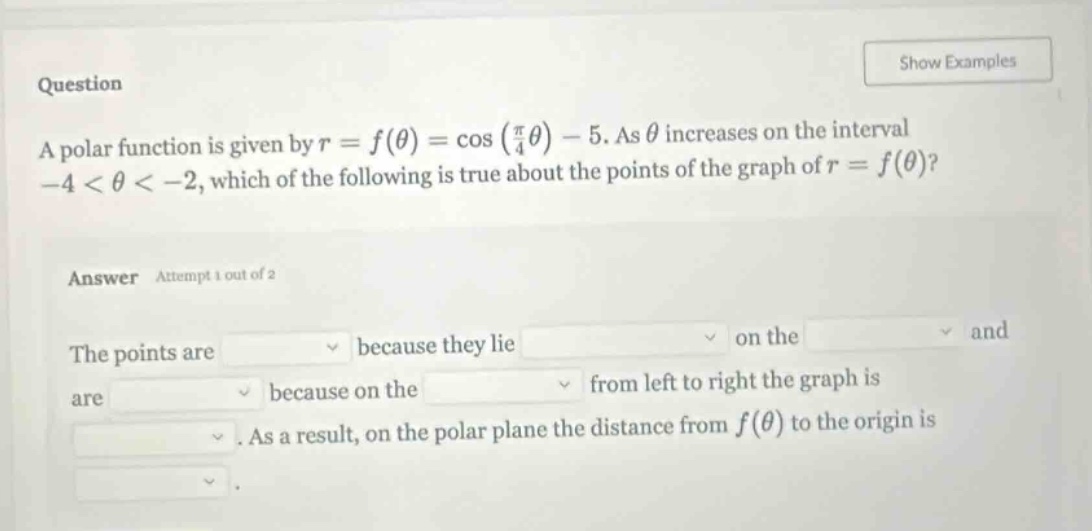
question a polar function is given by r = f(θ) = cos(π/4θ) - 5. as θ increases on the interval -4 < θ < -2, which of the following is true about the points of the graph of r = f(θ)? answer attempt 1 out of 2 the points are because they lie on the and are because on the from left to right the graph is. as a result, on the polar plane the distance from f(θ) to the origin is
Answer
Explanation:
Step1: Analyze the range of $\theta$
Given $- 4<\theta<-2$. Let $t = \frac{\pi}{4}\theta$. When $\theta=-4$, $t=\frac{\pi}{4}\times(-4)=-\pi$; when $\theta = - 2$, $t=\frac{\pi}{4}\times(-2)=-\frac{\pi}{2}$. As $\theta$ increases from $-4$ to $-2$, $t$ increases from $-\pi$ to $-\frac{\pi}{2}$.
Step2: Analyze the cosine - function behavior
The function $y = \cos t$ is increasing on the interval $[-\pi,-\frac{\pi}{2}]$. The function $r=\cos(\frac{\pi}{4}\theta)-5$. Since $\cos(\frac{\pi}{4}\theta)$ is increasing on the interval $-4 <\theta<-2$, then $r=\cos(\frac{\pi}{4}\theta)-5$ is also increasing on the interval $-4 <\theta<-2$. In polar coordinates, $r$ represents the distance from the point $(r,\theta)$ to the origin.
The points are moving away from the origin because they lie on the graph of $r = f(\theta)$ and are moving in the direction of increasing $\theta$ because on the interval $-4<\theta<-2$ from left - to - right the graph is increasing. As a result, on the polar plane the distance from $f(\theta)$ to the origin is increasing.
Answer:
The points are moving away from the origin because they lie on the graph of $r = f(\theta)$ and are moving in the direction of increasing $\theta$ because on the interval $-4<\theta<-2$ from left - to - right the graph is increasing. As a result, on the polar plane the distance from $f(\theta)$ to the origin is increasing.