question a polar function is given by r = f(θ) = sin((3/2)θ) - 2. as θ increases on the interval -4π/3 < θ <…
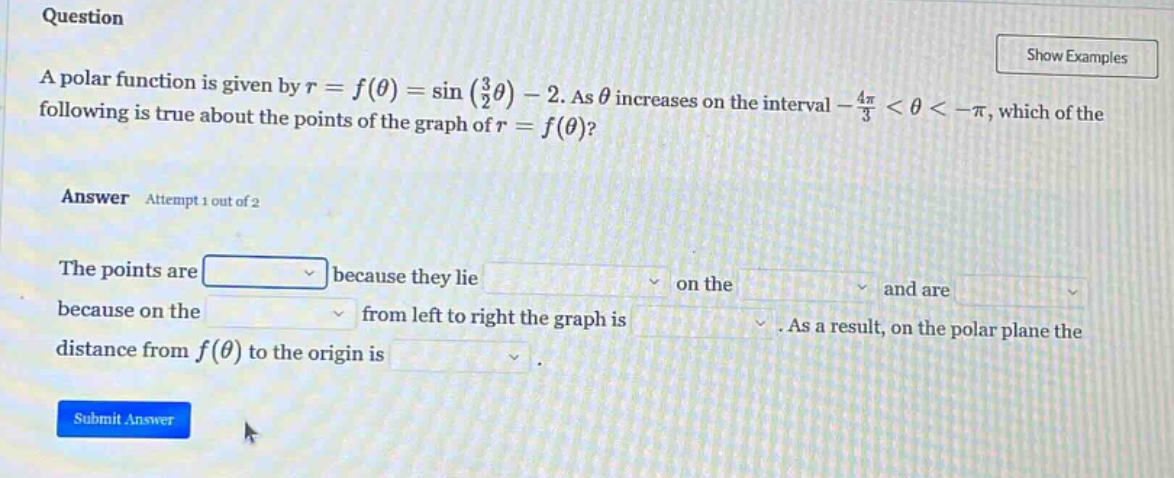
question a polar function is given by r = f(θ) = sin((3/2)θ) - 2. as θ increases on the interval -4π/3 < θ < -π, which of the following is true about the points of the graph of r = f(θ)? answer attempt 1 out of 2 the points are because they lie on the and are because on the from left to right the graph is. as a result, on the polar plane the distance from f(θ) to the origin is. submit answer
Answer
Explanation:
Step1: Analyze the function behavior
Let's consider the polar - function (r = f(\theta)=\sin(\frac{3}{2}\theta)-2). First, we know that the range of the sine function (y = \sin x) is ([- 1,1]). So, the range of (r=\sin(\frac{3}{2}\theta)-2) is ([-1 - 2,1 - 2]=[-3,-1]).
Step2: Analyze the interval
For (\theta\in(-\frac{4\pi}{3},-\pi)), let (u=\frac{3}{2}\theta). When (\theta=-\frac{4\pi}{3}), (u=\frac{3}{2}\times(-\frac{4\pi}{3})=-2\pi), and when (\theta =-\pi), (u=\frac{3}{2}\times(-\pi)=-\frac{3\pi}{2}). The function (y = \sin u) is increasing on the interval ([-\frac{3\pi}{2},-\frac{\pi}{2}]), and (u=\frac{3}{2}\theta) is increasing on (\theta\in(-\frac{4\pi}{3},-\pi)) since the coefficient of (\theta) is positive. As (\theta) increases in the interval ((-\frac{4\pi}{3},-\pi)), (u=\frac{3}{2}\theta) increases from (-2\pi) to (-\frac{3\pi}{2}), and (\sin(\frac{3}{2}\theta)) increases from (\sin(-2\pi) = 0) to (\sin(-\frac{3\pi}{2})=1). Then (r=\sin(\frac{3}{2}\theta)-2) increases from (0 - 2=-2) to (1 - 2=-1). In polar coordinates, (r) represents the distance from the point ((r,\theta)) to the origin. Since (r) is increasing on the interval ((-\frac{4\pi}{3},-\pi)) and (r<0), the points are moving closer to the origin. When (r < 0), the points are plotted in the opposite direction of the terminal - side of the angle (\theta).
The points are moving closer to the origin because they lie in the opposite direction of the terminal - side of the angle (\theta) on the polar plane and are moving in the positive (r) - direction (since (r) is increasing from (-2) to (-1)) because on the interval from left to right the graph of (r = f(\theta)) is increasing. As a result, on the polar plane the distance from (f(\theta)) to the origin is decreasing.
Answer:
The points are moving closer to the origin because they lie in the opposite direction of the terminal - side of the angle (\theta) on the polar plane and are moving in the positive (r) - direction because on the interval from left to right the graph of (r = f(\theta)) is increasing. As a result, on the polar plane the distance from (f(\theta)) to the origin is decreasing.